30-second summary
- There is no universal methodology, but there is a seven-step method to create your club’s own.
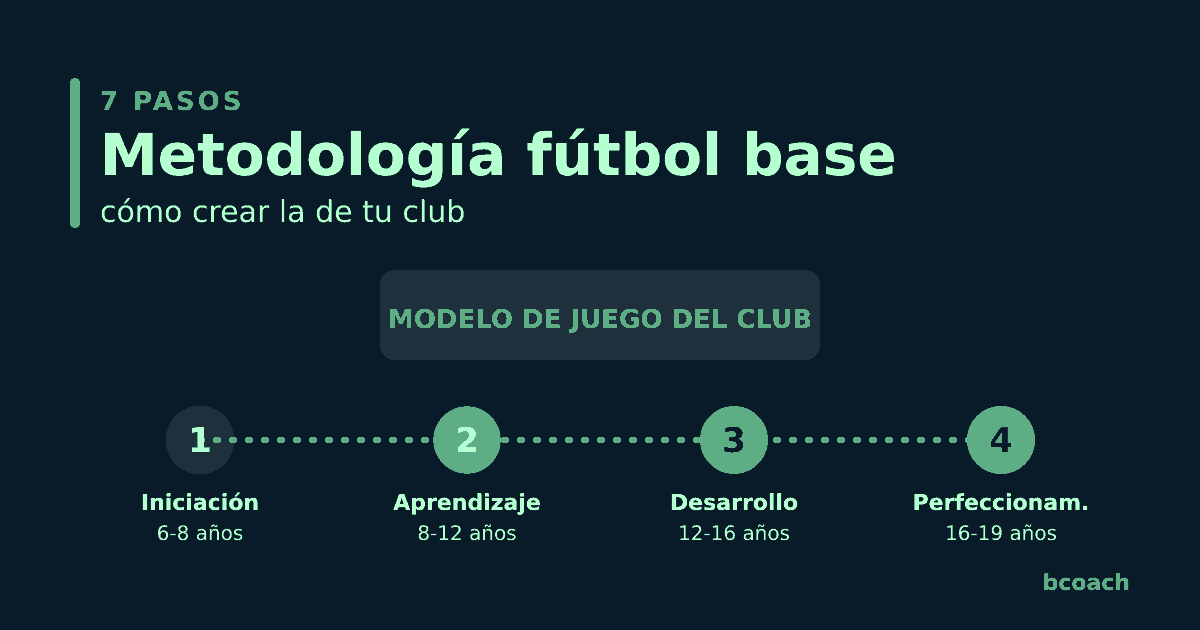
- Start with the club’s philosophy and values and adapt the content to the four developmental stages (ages 6 to 19).
- Define a clear game model for the four phases of the game, with a progression across age groups.
- Train with global, game-context tasks, and plan the season and sessions with a framework shared by all teams.
- Train your coaches and evaluate both the players and the methodology itself at the end of each season.
If you run or coordinate a sports academy, sooner or later you will ask yourself the same question: how do we make sure an under-10 today and an under-16 six years from now have received a coherent education, regardless of which coach they got? The answer is your own youth soccer methodology, written down, shared and reviewed every season. In this article, written for 2026, I explain how to build it from scratch, what to include, which mistakes to avoid and how to involve coaches, families and players.
Before we start, an honest clarification: there is no universal methodology that works the same way at every club. What does exist is a working method to create one. That is what you will find here.
What youth soccer methodology is and why your club needs it
One of the most common searches on this topic is “what is methodology in youth soccer?”. The short answer: it is the set of criteria, content, procedures and tools a club agrees on to develop its players from the day they arrive until they leave, both on the sporting side and the educational one.
A methodology is not a collection of drills or a nice PDF stuck in a drawer. It answers five questions:
- Why we develop players (club objectives and values).
- Who we develop (characteristics of each developmental stage).
- What we teach (technical, tactical, physical and psychosocial content).
- How we teach it (training style, type of tasks, coach’s role).
- How we know it works (evaluation and monitoring).
In the trenches, the lack of a methodology shows quickly: every coach reinvents training each September, players move up an age group and “start from zero”, and conversations with families revolve around results because the club hasn’t defined any other yardstick.
Reference examples: what you can learn from the big clubs
Many coaches search for “FC Barcelona youth methodology”, “Villarreal youth methodology” or “Valencia youth methodology” hoping to find a copyable formula. It is worth adjusting that expectation: professional clubs with academies publish their principles only partially, and what circulates online is usually coach-education material, talks or leaked internal documents of uneven quality. If you come across a Villarreal youth methodology PDF or a youth methodology PDF from another club, treat it with judgement: check the source and the date.
What is observable and useful from reference academies such as FC Barcelona (La Masia), Villarreal or Valencia:
- A defined playing identity that is recognisable in every age group.
- Continuity of principles between stages, with the complexity adapted.
- The importance of technique in context, with tasks that reproduce the game.
- A coordinating figure who ensures coherence.
- All-round development, including academic performance and values.
What you shouldn’t do is copy their game model without considering your own reality: number of players, facilities, your coaches’ training and budget. Take inspiration from the principles, not the carbon copy.
Step 1: define the club’s philosophy and values
Everything starts with a short document, one or two pages, that answers what kind of club you want to be. Bring together the board, coordinators and coaches and agree on:
- Mission: do we develop players, people, or both, and in what order of priority?
- Non-negotiable values: respect, effort, commitment, fair play.
- Success criteria: for example, number of players who move up a level, player retention, family satisfaction, and not just league position.
- Participation policy: guaranteed minutes in developmental stages, rotations, no early selection.
A practical tip: write these points in plain language. If a parent can’t understand the document in five minutes, it is no use as a communication tool. This step is the foundation of a youth soccer club’s methodology: everything you decide afterwards should be justifiable by it.
Step 2: know your players by developmental stage
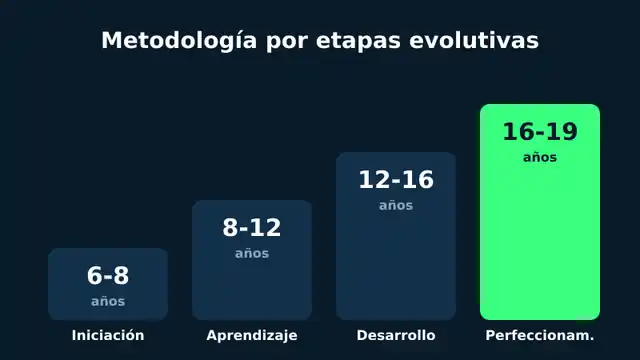
A useful methodology adapts content to the child’s age and development. An indicative outline, widely used in coach education in Spain:
| Stage | Approximate age | Main focus | Coach’s role |
|---|---|---|---|
| Initiation (U8) | 6-8 years | Free play, coordination, relationship with the ball | Animator, facilitator |
| Learning (U10-U12) | 8-12 years | Technique in context, small-sided games, basic understanding | Educator, guide |
| Development (U14-U16) | 12-16 years | Individual and group tactics, adapted physical capacities | Developer, strategist |
| Refinement (U18-U19) | 16-19 years | Competition, specialisation, psychological maturity | Coach, mentor |
Two important nuances. First, chronological age does not match biological age: within the same age group there are children with up to two or three years of difference in maturation, something to keep in mind when evaluating and selecting. Second, the limits are indicative: your methodology should describe what is expected at each stage but allow individual flexibility.
Step 3: design the club’s game model
The game model is the tactical heart of your methodology. It doesn’t need to be sophisticated; it needs to be clear and coherent. Define, at least:
General principles
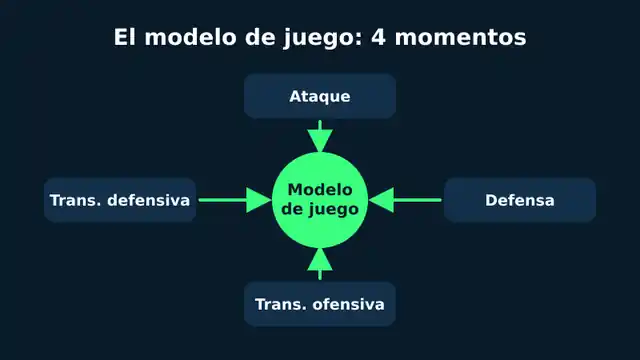
How we want to play in the four phases: attack, defence, offensive transition and defensive transition. For example: playing out from the back, pressing after losing the ball, sensible occupation of space.
Progression by age group
The same principle is worked at different depths. “Creating numerical superiority” can be a simple “pass and move” for an under-10, and for an under-16 the management of positional superiority between the lines.
Playing systems
Decide whether the club commits to a fixed system or to versatility. In development it is usually advisable for players to go through different positions well into adolescence.
A warning from experience: a game model that is too rigid at early ages penalises creativity and produces players who depend on instructions. Better a few principles, well trained, than a forty-page manual nobody applies.
Step 4: structure the content and the training methodology
This is where you land the training methodology in youth soccer. There is an established school of thought among educators that favours global, game-context tasks over analytical drills without opposition or decision-making. Without dogmatism, a reasonable mix includes:
- Small-sided games and situations (1v1, 2v2, 4v4, rondos, possession games) as the basis of training.
- Individual technical work integrated with progressive opposition.
- More structured tactical tasks as age increases.
- A match or final game to close the session.
Typical session structure
- Activation with the ball (10-15 minutes).
- Main part with 1 or 2 tasks connected to the week’s principle (30-40 minutes).
- Final game with rules that favour the content worked on (15-20 minutes).
- Cool-down and brief feedback (5 minutes).
The coach’s intervention style
Define in the methodology how coaching feedback is given: open questions, short pauses, positive reinforcement, avoiding monologues. It is what most separates a developer from someone who just directs.
Step 5: plan the season and the sessions
A good methodology turns into planning. Propose a shared framework for all teams:
- Macrocycle: season objectives by age group (preseason, quarterly blocks).
- Mesocycles: tactical or technical content to work on in blocks of 3-6 weeks.
- Weekly microcycle: distribution of content according to the available training days (at many clubs, two or three per week).
- Session sheets with objective, organisation, rules, variations and observation points.
The usual mistake is planning on paper and never reviewing. Set a short monthly coaches’ meeting to compare what was planned with what was done. If your club has limited resources, a shared spreadsheet with each team’s sessions is already a huge leap in coherence.
Step 6: train your coaches and create a club culture
You can have the best methodology in the world, but if the people coaching don’t understand it, it doesn’t exist. Many youth coaches are volunteers, parents or young people with another job. So:
- Present the methodology at a start-of-season day, with practical examples and not just slides.
- Organise cross-observation sessions: one coach attends another’s training and shares feedback.
- Support external education: there are youth soccer methodology courses and official coaching qualifications through regional federations and the RFEF, as well as private training. Always check the accreditation and syllabus before recommending one.
- Appoint a methodology coordinator with real time to support coaches, not just to manage schedules.
If you work with digital tools to organise club information, platforms such as bcoach United can help you centralise planning, sessions and communication between coaching staffs, so the methodology doesn’t depend on scattered documents.
Step 7: evaluate players and evaluate the methodology itself
Evaluating in youth soccer is not about giving grades or ranking children. It is gathering information to improve the process. Set up two levels:
Player evaluation
Use observable, age-appropriate indicators across four dimensions: technical, tactical, physical and psychosocial (attitude, teamwork, handling mistakes). Share the results with the player constructively: two strengths and one or two areas to improve, never a list of shortcomings.
Methodology evaluation
Ask yourself at the end of every season:
- Was it applied in all teams or only some?
- Which principles were understood and which weren’t?
- How do families and players rate the experience?
- How many players stay at the club from one year to the next?
With those answers, review the document. A living methodology is updated every season; a frozen one becomes irrelevant within two years.
Common mistakes when creating a club methodology
After seeing these projects rolled out in different settings, the failures repeat:
- Copying another club’s document without adapting it.
- Writing too much and applying too little: better 10 pages that get used than 80 nobody reads.
- Measuring success by results in developmental categories.
- Ignoring families: without communication, the methodology clashes with expectations of instant victories.
- No continuity: constant changes of coordinator and criteria every year.
- Forgetting the educational side: attendance, punctuality and respect for opponents and referees are also part of the method.
A good sign that you are on the right track: when a new coach arrives at the club and within two weeks understands how things are done, without anyone explaining it in a long meeting.
Conclusion: your methodology is built by training
Creating your club’s youth soccer methodology is a process, not a document. Start with the philosophy and values, adapt the content to each developmental stage, define a clear game model, turn everything into planning and sessions, train your coaches and evaluate honestly. Clubs that take these steps seriously don’t just improve their sporting results in the long run: they build an identity that attracts good coaches, retains players and earns families’ trust.
Your plan for this 2026 can be simple: gather your coaching staff, write a first one- or two-page version with the philosophy and playing principles, and test it for one season. Adjust what doesn’t work, keep what does, and before long you will have a methodology of your own, useful and recognisable.