30-second summary
- What a transition is: the switch from one phase of the game to the opposite when possession changes. There are two: defence-to-attack and attack-to-defence.
- When you win the ball, the first pass decides whether you exploit the opponent’s disorder; when you lose it, you must choose between counter-pressing and dropping back.
- To defend the opponent’s transitions, look after your defensive balance while attacking and control the first actions.
- Six drills with set-up, rules and variations: three for each transition.
- Train the switch between phases as a continuous sequence, not each phase separately.
If you have coached a team for a full season, you know the scene: your team dominates the ball, loses a pass in the opponent’s half and, three seconds later, is running backwards with half the squad out of position. That is where a good share of matches is decided. Soccer transitions are the moments immediately after a change of possession, and their quality separates teams that merely “have good ideas” from those that sustain them under pressure.
In this guide you will find the definition, the types, the principles of each transition, how to defend against an opponent who transitions well and six drills with set-up, rules and variations. All from the point of view of someone who has spent years on the pitch, not just at the whiteboard.
What soccer transitions are
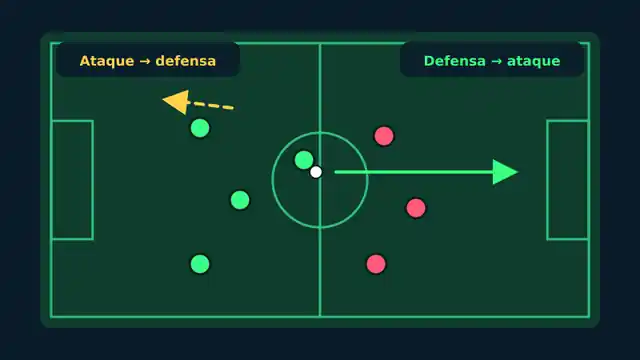
A transition is the switch from one phase of the game to the opposite at the moment possession changes. When your team wins the ball, it stops defending and must attack. When it loses it, it stops attacking and must defend. That passage is not instantaneous: it lasts a few seconds in which the team is disorganised, which is why it is the most vulnerable moment and also the most rewarding.
When someone asks what “making transitions” means, they are referring to the team’s ability to react in a coordinated way to that loss or recovery. A good transition does not depend on pure speed, but on three things:
- Prior collective decision: everyone knows what to do before the action happens.
- Anticipatory positioning: you play thinking about how you will react if you lose the ball.
- Immediate reaction: the first two or three seconds make the difference.
It is worth clarifying a term that appears a lot in searches: “ball transitions”. It is not a different category, but another way of naming the same thing: what happens when the ball changes hands. The key is that the transition is defined by the change of possession, not by the zone of the pitch or the outcome of the play.
How many transitions there are and what the types are
The most widespread answer in training methodology is that there are two transitions, part of the four classic moments of the game:
- Offensive organisation (positional attack).
- Attack-to-defence transition (after losing the ball).
- Defensive organisation.
- Defence-to-attack transition (after winning the ball).
Many coaches add a fifth moment, set pieces, but it is not a transition in the strict sense.
| Type of transition | When it happens | Main objective |
|---|---|---|
| Defence-to-attack (offensive) | You win the ball | Exploit the opponent’s disorder to progress or finish |
| Attack-to-defence (defensive) | You lose the ball | Prevent the counter-attack: press or drop back in an organised way |
Within each one you can distinguish subtypes by zone and by immediate decision. In the offensive transition: direct counter-attack, keeping the ball to secure possession, or a pause to reorganise. In the defensive one: pressing after the loss (counter-pressing), an intense drop back, or a tactical foul to stop the move. Choosing between them depends on the zone where the ball was lost, the number of players behind the ball and the score.
Defence-to-attack transition: what it is and how to execute it
The defence-to-attack transition is the moment you win the ball while the opponent is still organised to attack, with their players badly positioned to defend. That window is short, and most teams waste it for the same reason: the first pass is bad.
Principles of the offensive transition
- Quick first decision: is there space to progress or do you need to secure the ball? If there is a free vertical passing lane after winning it, you play there. If not, you protect the ball.
- Immediate width and depth: the most advanced players open the pitch or attack the space behind as soon as the ball is won, without waiting to see what a teammate does.
- Close support: the player who wins the ball needs at least one short, safe passing option.
- Exploit the weak side: the opponent is usually unbalanced towards where the ball was, so switching play is a very effective route.
A common case in youth categories
In youth and amateur soccer you see it constantly: the holding midfielder wins the ball and, instead of looking for the free player, dribbles into pressure. The solution is not shouting from the touchline, but designing tasks where winning the ball comes with a continuity rule (for example, the first pass must go to the free player in the opposite zone) until the decision becomes automatic.
Attack-to-defence transition: reacting when you lose the ball
The attack-to-defence transition starts at the exact second of the loss. One idea rules here: the best moment to win the ball back is right after losing it, because the opponent hasn’t yet organised their build-up. But it only works if the team is well positioned before the loss.
Counter-pressing or dropping back: how to decide
- Immediate counter-press (gegenpressing): you press the ball carrier for between one and four or five seconds, trying to win the ball back before the opponent organises. It requires closeness between lines and several players within a few metres of the ball.
- Organised drop back: if pressing isn’t viable, you quickly retreat into a defensive position, closing the central lane.
- Tactical foul: an infringement to stop the move is a legitimate tool when the opponent has numerical superiority and space behind you.
Principles of the defensive transition
- Pressure on the ball from the nearest player, aiming to prevent the vertical pass.
- Immediate cover from nearby teammates to close passing lanes.
- Closing the central lane: it forces the opponent to play wide, where there are fewer options.
- Prior balance: always keep a minimum safety structure (normally two or three players behind the line of the ball) while attacking.
How to defend the opponent’s transitions
If your opponent is a counter-attacking team, it is not enough to “get back quickly”. It is worth working on the problem before the loss.
Defensive balance when attacking
Before sending your full-backs forward, define who stays as cover. A practical and widely used rule is to leave three players behind the line of the ball when attacking with an advantage, although the exact number depends on the system and the opponent. What matters is that everyone knows who those players are in each phase.
Controlling the first actions
- Slow the carrier down: don’t dive in; back off and force a bad decision, buying time to recover shape.
- Protect the space between centre-back and full-back: it is the channel through which through-balls usually arrive.
- Prevent the vertical pass: closing the passing lane to the striker is more valuable than winning the ball.
- Change the rhythm: if the opponent transitions well at speed, avoid disorganised counter-presses, which only leave space behind you.
Common mistakes you see on the pitch
After many sessions, patterns repeat that deserve correcting with concrete tasks:
- Everyone runs to press: without cover, the opponent beats the first press and finds an open field.
- The team stretches: if the lines are further apart than is reasonable, no counter-press is possible.
- Counter-attacking without support: the player who wins the ball advances alone and loses it again, restarting the defensive cycle.
- Training only speed: running more doesn’t replace deciding better. Transitions are won with head, position and communication.
- Not training the transition as a sequence: many teams practise “attack” and “defence” separately, but not the switch between them, which is where matches are lost.
A tip that helped me a lot: film your training from a high position and count how many seconds your team takes to react after a loss. Seeing it is usually more convincing than any explanation.
Drills for the defence-to-attack transition
These three drills work on winning the ball and playing out quickly. You can adapt them to your age group by adjusting spaces and numbers of players.
1. 4v2 rondo with a mini-goal exit
- Space: a 12 x 12 metre square, with two mini-goals on one side.
- Set-up: four attackers keep possession against two defenders. If the defenders win the ball, they must break out dribbling towards the mini-goal.
- Objective: that whoever wins the ball makes the right decision in under two seconds.
- Variation: reduce touches to one or two to raise the tempo.
2. Conditioned 5v5 with a neutral goal
- Space: half a pitch, with one big goal and two mini-goals at the other end.
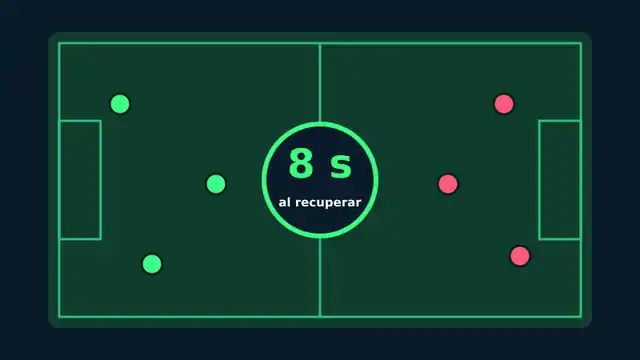
- Key rule: after winning the ball, the team has eight seconds to finish. After that, the play restarts.
- Objective: improve progression after winning the ball.
- Variation: double points if the goal comes within a maximum of three passes.
3. Positional game with a switch of play
- Set-up: 6v4 in a long space divided into three lanes.
- Rule: after winning the ball, it must go through the opposite lane first before progressing.
- Objective: exploit the opponent’s weak side after winning the ball.
Drills for the attack-to-defence transition
Here the focus is on reacting quickly to the loss and reducing the opponent’s space.
4. Possession with a five-second counter-press
- Space: 20 x 25 metres.
- Set-up: 7v5, with an outside joker.
- Rule: after losing the ball, the team has five seconds to win it back. If it does, it scores a point. If not, the opponent tries to pass to a target zone.
- Objective: automate immediate pressing and closeness between players.
5. Attack against defence with immediate transition
- Set-up: one team attacks 6v5 in one third of the pitch. If it loses the ball, it must drop back to a marked line before the opponent connects with a striker positioned in the opposite half.
- Objective: improve the intense drop back and prior balance.
- Variation: add an attacking-team player who stays as fixed cover to work on anticipation.
6. End-to-end game with two goals
- Space: a 40 x 30 metre pitch, with goals at each end.
- Rule: when you lose the ball, you must win it back in under six seconds or drop back to your half before the opponent crosses the halfway line.
- Objective: experience the transition in a match context, with real decisions.
How to progress and plan these tasks during the week
Transitions are not trained in a single session. A sensible approach is to spread them across the microcycle: sessions with a higher cognitive load and small spaces at the start, and wider, more match-like games at the end.
Proposed progression
| Phase | Type of task | Priority aspect |
|---|---|---|
| Start of the week | Rondos and small spaces | Speed of decision |
| Mid-week | Positional games with rules | Organisation and communication |
| End of the week | Conditioned match | Application in real situations |
To design and communicate these tasks to your players, a good tool is a soccer tactical board: it lets you draw starting positions, movements and rules, and share them with the group before going out onto the pitch. Anyone who sees the task clearly saves a lot of explanation time in the session.
How to measure whether it works
- Number of recoveries in the first five seconds after a loss.
- Average time to the first pass after winning the ball.
- Opponent chances after a loss in your attacking half.
You don’t need advanced tools: a simple record sheet during the match or video afterwards is enough to see trends.
Conclusion
Transitions in soccer are not a tactical add-on, but a moment of the game as important as positional attack or organised defence. Understanding what they are, telling the defence-to-attack transition from the attack-to-defence one and training them as a continuous sequence will give you a real edge, whatever your age group.
Remember the essentials: decide before the action happens, keep your balance while attacking, react in the first seconds and train the switch between phases, not just each phase on its own. Start this week with one drill from each block, measure how long your team takes to react and adjust based on what you see. With consistency, transitions will go from being your weak point to becoming your best competitive weapon in 2026.