Mastering build-up play from your own penalty box is neither a matter of luck nor about piling up dozens of static diagrams in a notebook. If you are looking for the best drills to improve build-up play in football, you must understand that clean, fluid progression stems from your players’ ability to read space, detect opponent pressure, and execute accurately under stress. In modern football, where aggressive high pressing and man-to-man marking have become the standard, playing out from the back with clear intent marks the difference between dictating the match and conceding clear goal-scoring opportunities in high-risk zones.
Across years spent in the dugout and after analyzing hundreds of training sessions across various competitive tiers, the most frequent mistake coaches make is not a lack of drills, but training the build-up phase completely out of context. An eye-catching drill serves no purpose if the center-back does not understand why they must fix their direct opponent, or if the pivot fails to open their body shape toward their back foot.
In this comprehensive guide, we break down the tactical fundamentals of build-up play alongside a progressive battery of practical exercises—from analytical mechanization to realistic match scenarios—so your squad learns to break through pressing lines with confidence and precision.
Key Tactical Fundamentals Before Designing Build-Up Drills
Before laying down cones and directing players where to stand, it is essential to establish the core principles governing any successful build-up. Without these foundations, drills turn into mechanical routines that unravel the moment an opponent adjusts their defensive structure.
Identifying Space and Execution Timing
Building out from the back is a tactical race against the opponent’s press. The ball carrier—usually the goalkeeper or one of the center-backs—often enjoys the most time and space during the initial seconds of the sequence. The collective objective is not merely to hoof the ball forward, but to manage that time to draw opponents in, create pockets behind the first pressing line, and find the free man at the exact right moment.
Body Orientation and Receiving on the Back Foot
A poorly oriented first touch instantly ruins any tactical advantage created beforehand. Requiring center-backs, full-backs, and midfielders to receive open toward the field on their back foot (the foot farthest from where the pass originated) broadens their visual field, helps them scan incoming pressure, and lets them move the ball in one or two touches. Receiving across the body on the near foot turns the player back toward their own net, choking off passing angles and inviting immediate pressure.
The Third-Man Dynamic and Committing Opponents to Free Teammates
To break through compact defensive blocks, direct passing lanes into target players are often blocked by an opponent’s cover shadow. This is where the third-man dynamic proves vital: Player A plays into Player B (who draws defensive pressure), and Player B lays the ball off with a single touch to Player C, who arrives facing forward with time and space.
Meanwhile, fixing (committing) an opponent means driving forward on the dribble directly toward a defender to force them out of their zone, leaving a teammate completely unmarked. If a center-back releases the ball too early without committing anyone, the defender can float and comfortably screen two passing lanes at once.
Analytical and Pattern Drills (RT1): Building the Habit
Pattern-based drills automate technical mechanics and body orientation without the chaos of direct, aggressive opposition. They are ideal during activation or the initial technical segment of a tactical block.
Drill 1: 2v1 Center-Back Circulation vs. Forward with Line-Breaking Pass
- Objective: Automate center-back commitment, defensive shifting, and back-foot body shape.
- Players: 2 center-backs, 1 central midfielder, and 1 opposing forward (acting semi-actively).
- Space: 20×20 meters in the defensive third.
- Execution: Center-back 1 starts with the ball. The opposing forward moves to cut off the direct passing lane into the midfielder. Center-back 1 drives forward on the dribble to commit the forward, releasing a lateral pass to Center-back 2 the moment the striker steps up. Center-back 2 must receive across their body onto the back foot and punch a firm line-breaking pass into the midfielder checking between the lines.
- Key Coaching Points: Ensure the first center-back drives forward aggressively to pull the forward in. The pass across to the second center-back must be played firmly into their back foot.
Drill 2: Diagonal Passing Circuit to Commit and Lay Off
- Objective: Master triangulations between wide players, interior midfielders, and the free man.
- Players: 6 to 8 players per station.
- Space: Diamond layout measuring 25×15 meters.
- Execution: The full-back plays a crisp pass into an interior midfielder checking toward the ball. Under pressure from an imaginary marker, the midfielder plays a one-touch layoff back to the supporting center-back or holding midfielder. That player switches play in two touches into the opposite channel, where the opposite full-back overlaps at speed.
- Key Coaching Points: Timing of the checking run is critical: the player must arrive onto the ball on the move rather than waiting flat-footed. The weight of the layoff dictates whether the switch cleanly beats the line or falls short.
Rondos and Positional Games Under Pressure (RTD)
Once the basic mechanics are locked in, real-time decision-making must be introduced through contextualized rondos and positional play.
Drill 3: 4v2 + 2 Interior Neutrals Rondo with Zonal Transitions
- Objective: Break the first pressing line by using interior neutral players acting as holding midfielders.
- Players: 4 outside players (2 center-backs, 2 full-backs), 2 interior neutrals, and 2 defenders.
- Space: 18×18-meter grid divided into two equal halves.
- Execution: Outside players and neutrals maintain possession. To score a point, the attacking side must connect at least 4 passes in the first zone before playing a penetrative pass into a neutral in the second zone, who must lay it off or turn if unpressured. If defenders win the ball, they look to score into two mini-goals placed along the perimeter.
- Key Coaching Points: Constantly look for diagonal passing lanes instead of flat, horizontal passes. Demand quick verbal communication between interior neutrals and perimeter players.
Drill 4: 6v4 + Goalkeeper Positional Game from Goal Kicks
- Objective: Replicate realistic build-up under a high press inside a constrained area.
- Players: Goalkeeper + 4 defenders (2 center-backs, 2 full-backs) + 2 holding midfielders vs. 4 pressing forwards.
- Space: From the end line to the halfway line across the full width of the pitch.
- Execution: Play always restarts with the goalkeeper taking a goal kick. The possession team aims to break past the halfway line either on the dribble or by connecting a grounded pass into any of the three mini-goals stationed across the dividing line. The 4 pressing attackers apply maximum pressure to win possession and finish on the full-size goal within 8 seconds.
- Key Coaching Points: Actively integrate the goalkeeper as an extra outfield player to guarantee a 6 + GK vs. 4 overload. Alternate the opponent’s pressing scheme so players learn to navigate both zonal and man-oriented setups.
Preferential Simulation Drills (SSP) and Match Play
To ensure direct transfer to matchday, sessions must feature simulation drills that mirror the structural patterns of your game model.
Drill 5: Zonal 4v3 Build-Up with Overlapping Full-Backs
- Objective: Exploit numerical overloads in wide areas via center-back dribbles or penetrative runs.
- Players: 4 defenders vs. 3 forwards.
- Space: Three-quarters of a regulation pitch.
- Execution: Wide and central corridors are marked off. Direct aerial clearances are prohibited. The build-up unit must circulate centrally to draw the defensive block inward, then quickly shift play wide to the free full-back. Once the full-back receives, an interior midfielder underlaps or overlaps to create a 2v1 down the flank and break the midfield line.
- Key Coaching Points: If the opponent packs the middle, exploit the flanks at pace. Ball speed must be high enough to outpace the defensive shifting of the opponent.
Drill 6: 11v11 Conditioned Match on Three-Quarter Pitch
- Objective: Full-scale transfer of the game model across both the build-up and consolidation phases.
- Players: 11 vs. 11.
- Space: Three-quarters of a standard pitch.
- Execution: Full game dynamics with conditioned scoring: if the building team plays out from the goalkeeper with grounded passes, links with the midfield line, and finishes with a shot on target, they earn 2 points. Scoring a goal from a clean build-up awards 3 points. If the pressing team forces a high turnover in the defensive third and scores, their goal counts double.
- Key Coaching Points: Assess the composure of the backline under intense competitive pressure. Clearly identify the trigger point where playing short is compromised and a long pass into the second ball becomes necessary.
Summary Comparison of Build-Up Drills
| Drill Type | Cognitive Load | Opposition Level | Primary Objective | Ideal Microcycle Day |
|---|---|---|---|---|
| Mechanization (RT1) | Low / Medium | Semi-active / None | Automate body shape and receiving on the back foot | MD-4 / Session warm-up |
| Rondos / Positional (RTD) | High | Active restricted | Decision-making, third-man concepts, and support play | MD-3 / MD-4 |
| Simulation Drill (SSP) | Very High | Real zonal | Breaking specific opponent pressing schemes | MD-3 |
| Conditioned Match | Maximal | Full 11v11 | Global game model transfer and stress control | MD-2 / MD-3 |
How to Plan and Design Your Build-Up Sessions
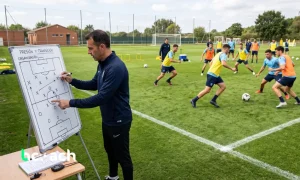
In modern academy and senior football, explaining intricate phases of play through static chalkboard drawings prior to training is no longer enough. Players absorb information visually and require clear tactical animations they can review before stepping out onto the grass.
To speed up prep work and stop wasting time diagramming drills by hand, relying on a modern football coaching app has become an indispensable asset. Digital platforms allow coaching staffs to:
- Design drills in 2D and 3D: Set up field boundaries, marked zones, and starting lineups with exact precision.
- Build dynamic animations: Walk players through movement patterns, pass paths, and unit shifts before executing them on the pitch.
- Manage training load: Regulate playing areas and recovery intervals to avoid accidental fatigue spikes across the weekly microcycle.
- Share drill cards with players: Distribute the match plan directly to players’ mobile devices to maximize on-pitch training minutes.
Common Build-Up Mistakes and How to Correct Them
Even when running structured drills to develop build-up play, common conceptual errors can stall progress:
- Fixating on the ball and losing spatial awareness:
Defenders often fall victim to tunnel vision, focusing so heavily on controlling the ball that they fail to spot approaching markers.
Solution: Require players to complete two shoulder checks (visual scans) before receiving the pass to assess pressure and passing options. - Standing flat in the passer’s direct line:
If a midfielder or full-back stays flat along the same line as the passing center-back, they make interceptions simple for the defender.
Solution: Insist on staggered positioning across different depths and sharp diagonal movements to create clean passing lanes outside the opponent’s cover shadow. - Rushing play without drawing the opponent out:
A frequent mistake driven by nerves is attempting forced vertical passes before the opposing defensive structure has shifted or loosened.
Solution: Reward patient horizontal circulation. Teach center-backs that moving the ball from side to side forces opposing attackers into fatiguing lateral shifts, which eventually opens up central passing lanes.
Tactical Consistency and Game Reading to Dominate Build-Up Play
Improving your team’s build-up play is not about magical formulas or copying exercises out of context. Long-term success relies on intentional repetition, fine-tuning technical details—such as the back foot and supporting angles—and ensuring every player understands the tactical logic behind each pass.
Pairing analytical pattern work, contextual rondos, and conditioned match scenarios across your weekly microcycle provides players with the confidence needed to break any high press. With structured preparation and modern digital tools to communicate your tactical identity, playing out from the back will become one of your squad’s greatest competitive advantages.