Modern football has evolved by leaps and bounds. Looking back and comparing today’s game in 2026 to that of just a decade ago, it is clear that the sport has become blistering. Players are faster, duels are more intense, and transitions unfold at breakneck speed. In this context, understanding the different types of strength in football and knowing how to transfer that physical preparation onto the pitch makes the difference between a team that dominates for 90 minutes and one that fades in the final stretch.
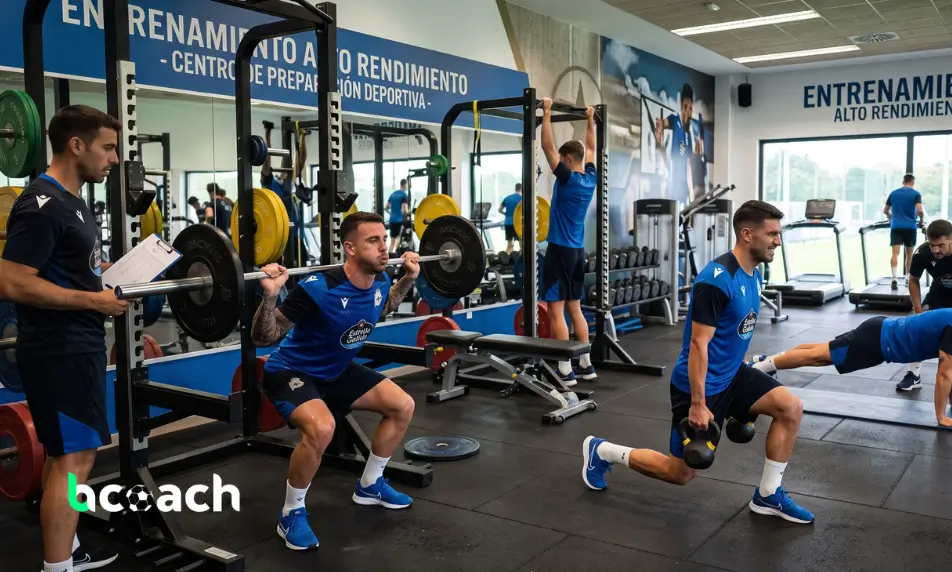
I vividly remember my early years as a strength and conditioning coach. Fresh out of university, my notebook was filled with traditional gym routines: heavy squats, leg presses, and bench presses. I thought that if I could get my players moving more weight, they would be unstoppable. Reality dealt me a harsh blow during the first month of pre-season: I had athletes who were strong in the weight room, yet slow out of turns, clumsy during decelerations, and prone to muscle overload the moment they stepped onto the pitch. That was when I realized strength in football is not measured in weight plates, but in the capacity to apply force in the shortest time possible, along specific vectors, and with a ball involved.
In this article, we will break down the types of strength in football, how they manifest in every match action, and, most importantly, how you can design on-pitch strength sessions that are functional, efficient, and directly transferable to competitive play.
Why is football strength different from gym strength?
To grasp the types of strength in football, we must first debunk a widespread myth: building muscle mass does not automatically make a player stronger on the pitch. Football is a dynamic, intermittent, acyclic, and multi-directional sport.
Professor Juan José González Badillo, a leading authority on strength training, emphasizes that the only strength that truly matters in sport is useful strength: the force an athlete can apply at the speed and in the direction of the specific sporting action.
When a winger makes a line-breaking run, they need more than maximal quadriceps and glute strength. They require:
- Explosive strength to overcome inertia in the first three steps.
- Eccentric and elastic-reactive strength to brake to a complete stop before changing direction.
- Core stability and upper-body traction strength to withstand contact from a defender without losing balance.
- Strength endurance to repeat that same maximal effort 25 times over 90 minutes.
Strength in football operates as an interconnected system where the central nervous system (CNS) plays a decisive role in coordinating motor unit recruitment.
The 4 key types of strength in football performance
Modern training methodology categorizes strength manifestations according to the tactical and physical demands of the game. Below, we break down the four essential types of strength every coaching staff should master.
1. Maximal strength: The structural foundation
Maximal strength is the peak force the neuromuscular system can generate via voluntary contraction. In football, maximal strength is not pursued for hypertrophy or aesthetics, but as the neurophysiological base supporting power and speed.
- Match manifestation: Shoulder-to-shoulder duels, shielding the ball with back to goal, static aerial challenges, and structural injury prevention.
- Scientific evidence: Biomechanical research in elite football shows that higher performance in the full squat and deadlift directly correlates with superior 10- and 20-meter sprint acceleration.
- How to train it: Primarily developed in the gym or through high-load resisted sled towing on the pitch, targeting neural adaptations (recruitment and synchronization of motor units) rather than excessive body mass gains.
2. Explosive strength / power (RFD – Rate of force development)
RFD is the ability to produce the maximum amount of force in the shortest possible time window. In modern football, the opportunity to execute a decisive action typically lasts between 100 and 300 milliseconds. If players take 500 milliseconds to express peak force, the opponent will reach the ball first.
- Match manifestation: Sprint starts, explosive bursts, headers for finishing or clearing, powerful shots on goal, and sharp accelerations.
- Key concept: The priority is not the absolute load lifted, but the speed at which the athlete accelerates their own body weight or an implement.
- How to train it: Through plyometrics (horizontal and vertical jumps), contrast training (heavy loaded sets followed immediately by short sprints), and hurdle jumps paired with on-pitch sprint transitions.
3. Elastic-reactive and eccentric strength: Deceleration and injury prevention
For decades, coaches focused almost exclusively on accelerating the player. However, modern match play demands between 600 and 800 changes of direction and decelerations per game. Efficient deceleration mechanics dramatically lower joint stress on knees and ankles.
- Eccentric Strength: Occurs when a muscle lengthens while under tension. It is essential for absorbing mechanical kinetic energy during landings and hard stops.
- Elastic-Reactive Strength: Relies on the Stretch-Shortening Cycle (SSC). The muscle-tendon complex acts like a spring, storing elastic strain energy during the eccentric phase and releasing it concussively in the concentric phase.
- Match manifestation: Cuts, feints, 180-degree turns, defensive jockeying, and landing mechanics post-jump.
- Injury prevention: Targeted eccentric strength for the hamstrings (using protocols like the Nordic Hamstring and Copenhagen exercises) reduces hamstring strain risk by up to 50%.
4. Strength endurance: Sustaining output across 90 minutes
A player capable of an initial sprint at 33 km/h offers little value if their force output drops by 40% by the 70th minute. Strength endurance in football is the body’s capacity to maintain optimal force production throughout the match while resisting neuromuscular fatigue.
- Match manifestation: Retaining ball-striking quality in late minutes, winning aerial duels in stoppage time, and executing high-intensity recovery runs late in the game.
- How to train it: Through ball-integrated circuits, Small-Sided Games (SSGs) with tight spatial and temporal constraints, and high-intensity intermittent interval blocks.
Comparison table: Strength types and on-pitch application
| Strength Type | Key Factor | Match Action | Primary On-Pitch Method |
|---|---|---|---|
| Maximal Strength | Motor unit recruitment | Contact duels, shielding the ball | Heavy sled pushes/pulls, resisted sprints |
| Explosive Strength | Rate of Force Development (RFD) | 0–10m sprint bursts, heading jumps | Plyometrics, hurdle jumps to sprint |
| Eccentric / Elastic | Impact absorption & SSC | Decelerations, sharp cuts, turns | Drop landings, controlled hard braking |
| Strength Endurance | Fatigue resistance | Sustained intensity over 90 mins | High-tempo technical circuits, SSGs |
How to transfer strength onto the pitch
The core challenge for the modern performance coach is ensuring gym adaptations transfer directly to match play. We achieve this through Structured Training models and sport-integrated drill design.
An effective on-pitch strength session follows a logical neurophysiological progression:
- Dynamic Activation & Mobility (10 min): Gluteus medius activation, multi-planar hip mobility, and core work for lumbo-pelvic control.
- Post-Activation Potentiation (PAP) / Plyometrics (15 min): High-quality neural work without residual fatigue (hops, reactive ankle stiffness drills).
- Strength-Speed Drills (15 min): Sleds, resistance bands, programmed decelerations, and changes of direction with or without opposition.
- Tactical Integration with Ball (20–30 min): Match situations (1v1, 2v2, or tight positional play) demanding the exact movement mechanics targeted in the earlier blocks.
To design, structure, and document these sessions clearly, digital tools are indispensable. Using a football coaching app allows coaches and fitness staff to digitize on-pitch strength workouts, map drills on an interactive tactical board, and manage squad workloads with precision.
On-pitch strength drills that preserve tactical context
Here are 3 practical circuits you can implement directly into your weekly training program.
Circuit 1: Plyometric power + acceleration + finishing
Objective: Develop explosive and elastic-reactive strength with direct transfer to shooting on goal.
Equipment: 4 mini hurdles, 1 medicine ball (3–4 kg), footballs.
- The player completes 4 continuous double-leg hurdle jumps, minimizing ground contact time (elastic-reactive strength).
- Landing off the final hurdle, they receive a firm pass and play a one-touch return.
- Immediately sprint 5 meters forward, pick up a medicine ball, and execute an explosive chest pass throw.
- Make an angled attacking run to meet a cross from wide and finish with a single touch.
- Volume: 2 to 3 sets of 4 repetitions per side. Full recovery (90 seconds between reps).
Circuit 2: Eccentric strength in 1v1 duels + transition
Objective: Train deceleration, collision strength in duels, and transition strength endurance.
Equipment: Cones, resistance bands or harness systems.
- Two players face each other inside a 10×10-meter grid. One player is tethered to a resistance band restraining forward movement.
- The resisted player performs 3 high-intensity eccentric braking steps against band tension to hold position.
- On the coach’s whistle, a 50/50 loose ball is played into the center of the grid.
- The resistance is released, and both athletes contest an open 1v1 duel to score in a mini-goal.
- Volume: 4 repetitions per player with 2-minute recovery intervals.
Circuit 3: Integrated strength endurance (3v3 Small-sided game + neutrals)
Objective: Build force-generation capacity under combined aerobic and anaerobic fatigue.
Pitch Size: Restricted space (25×20 meters) with mini-goals.
- High-intensity 3-minute bouts.
- Mandatory counter-press for the first 5 seconds following turnover.
- Tight dimensions force constant accelerations, braking, rapid direction changes, and physical challenges.
- Volume: 4 blocks of 3 minutes with 1.5 minutes of active rest between sets.
Weekly strength periodization (Structured microcycle)
The timing of strength exposure during the microcycle determines its efficacy while mitigating injury risks ahead of the weekend match. In a standard Sunday-to-Sunday schedule (MD = Match Day), on-pitch strength loading follows this progression:
- Monday (MD+1): Recovery and compensatory training.
- Tuesday (MD-5): Rest day or individualized maintenance.
- Wednesday (MD-4) – Strength / Tension Day (Small Spaces): The primary on-pitch strength session. Conducted in small spaces with high densities of decelerations, cuts, jumps, and contested duels. Mechanical, isometric, and eccentric demands are elevated.
- Thursday (MD-3) – Speed / Space Day (Explosive Strength): Muscular tension drops while high-speed running distance increases. Emphasizes explosive strength across 15–20+ meter sprint distances and wide-space counter-attacks.
- Friday (MD-2) – Neural Activation: Very low volume at maximal intensity. Low-amplitude plyometrics and short 5-meter acceleration bursts to sharpen the nervous system without inducing residual fatigue.
- Saturday (MD-1): Pre-match tactical walk-through and neuromuscular activation.
- Sunday (MD): Match Day (Peak Performance).
5 Common mistakes in on-pitch football strength training
Even in professional environments, specific methodological errors still compromise player output. Avoid these common missteps:
- Inducing excessive fatigue before tactical work: Running taxing eccentric strength circuits immediately before a complex tactical session strips players of the neural sharpness needed to assimilate tactical concepts.
- Confusing strength training with cardiovascular circuit fatigue: 20-station endless circuits without adequate rest do not train explosive power; they merely generate excessive lactate and degrade running mechanics.
- Overlooking deceleration training: Focusing entirely on acceleration without coaching landing and deceleration mechanics creates a prime environment for ACL tears and soft-tissue injuries.
- Failing to individualize loads: A 1.90 m, 85 kg center-back has different neurophysiological profiles and force-velocity demands than a 1.68 m, 62 kg winger.
- Neglecting progressive overload: Introducing high drop-box jumps mid-season without progressive tendon conditioning leads to immediate shin splints and patellar tendinopathies.
Understanding the different types of strength in football and applying them purposefully on the pitch remains a core asset for the modern coaching staff. Strength is not an end in itself; it is the physical engine that enables players to execute tactical actions with precision, speed, and authority across the entire 90 minutes.
Integrating maximal, explosive, eccentric, and endurance strength into daily on-pitch routines optimizes session efficiency, sustains player engagement through constant ball contact, and minimizes soft-tissue injuries.
Structure your sessions with intent, protect recovery intervals to favor quality over quantity, and leverage digital tools to build reliable, high-performing weekly training microcycles.