30-second summary
- What it is: a methodology created by Vítor Frade (University of Porto) that organises the week around the game model, not around isolated physical capacities.
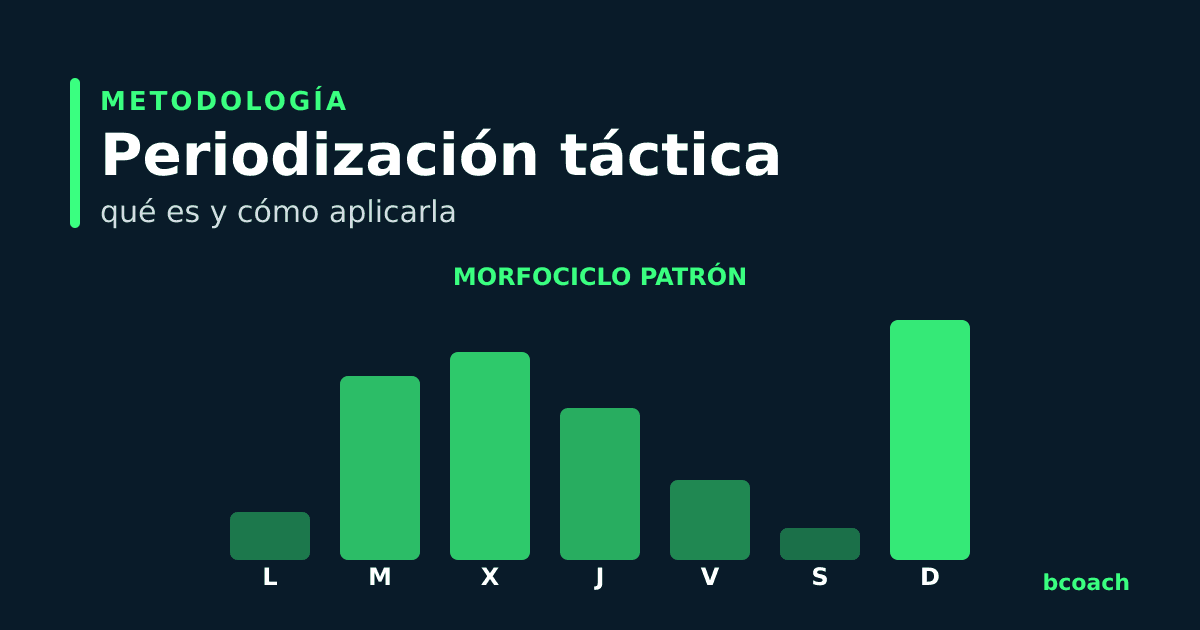
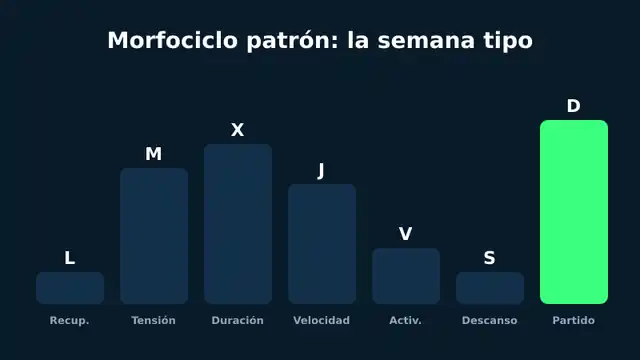
- Standard morphocycle: the week is ordered into recovery, tension, duration, speed, activation and match.
- It is not the same as the structured microcycle (Paco Seirul·lo): a fixed standard morphocycle versus a more flexible structure.
- How to start: write down your game model, define the sub-principles, build a realistic standard week and evaluate every week against the match.
- Main risk: copying the forms without understanding the substance.
Tactical periodization is a training methodology that organises the whole working week around the team’s game model, and not around isolated physical capacities. If you have ever trained with the classic block of continuous running, then strength, and finally “a small game”, you know the player ends up running a lot and understanding little. This methodology was born precisely to break that split: here the player gets fit by playing soccer, with the idea of the game as the axis of every task.
In this article you will find what it is, who created it, its principles and characteristics, how the standard morphocycle is structured, how it differs from the structured microcycle, which drills represent it and how to implement it in a real team, with common mistakes and field tips. If you are looking for the groundwork first, we recommend reviewing how to plan a soccer training session.
What tactical periodization is and who created it
Tactical periodization is a training model in which the game model is the axis that orders everything: content, loads, progressions and recovery. It doesn’t separate the tactical, technical, physical and psychological, but treats them as inseparable dimensions of a single reality, the game.
Its creator is Professor Vítor Frade, a lecturer at the University of Porto (Faculty of Sport), who developed the proposal from the 1980s and 1990s in the Portuguese academic world. That is why you often see the term “the Vítor Frade method”. Although you sometimes hear “who invented tactical periodization” as if it were a closed method, it is worth clarifying that Frade presents it as an epistemology, a way of understanding training, rather than as a recipe of drills.
Its worldwide spread came through coaches trained in that environment, the most high-profile being José Mourinho, and through popularisers such as Xavier Tamarit, whose work on the methodology in Spanish is a reference. If you search for a “tactical periodization book”, Tamarit’s is the usual starting point.
Training periodization versus tactical periodization
Many people search for “what is training periodization”. It is the organisation of load over time (macrocycles, mesocycles, microcycles) to reach peak performance at key moments. Tactical periodization is one specific, and quite different, way of doing it: instead of periodizing conditioning capacities, it periodizes the tactical content of the game model.
Principles of tactical periodization
The principles of tactical periodization are the conceptual framework of the method. The three most cited are:
- Principle of propensities: training doesn’t mechanically determine what will happen, but generates tendencies or “propensities” towards certain behaviours. The coach creates contexts where what he is looking for is more likely to appear.
- Principle of horizontal alternation in specificity: each day of the week has a different load emphasis (tension, duration, speed), preventing the player from accumulating the same type of stress on consecutive days.
- Principle of complex progression: content is introduced and consolidated gradually, integrating several dimensions at once.
To these are added the concepts of specificity (training must resemble the game you aim to play), playing to train and training to play and the unity of the player, understood as a whole.
What the principle of propensities means in practice
An example: if your model requires playing out with the holding midfielder between the centre-backs, explaining it on the whiteboard is not enough. You design a positional game with superiority in the first zone and rules that reward that build-up. Repeated over weeks, the propensity appears without the player having to think about it.
Characteristics of tactical periodization
The characteristics of tactical periodization that set it apart from other approaches are:
- Game model as a guide: everything starts from a clear, defined idea of how you want to play.
- Integrated task: drills always include the ball, opposition, game objectives and a cognitive component.
- Sub-principles and sub-sub-principles: the game is broken down into moments (offensive organisation, defensive organisation, transitions and set pieces) and fractions consistent with the whole are worked on.
- Adherence to a standard week: the structure repeats every week with few variations.
- Specificity and no transfer: training already is the content; you don’t train “to transfer” later.
- Recovery management: rest is scheduled as an active part of the process.
- Own language: specific terminology is used (morphocycle, propensities, level of organisation).
A key point that is often overlooked: the method demands coherence between discourse and task. If the coach’s language in the dressing room doesn’t match what is seen in the drill, the method is emptied of meaning.
The standard morphocycle: how the week is structured
The standard morphocycle of tactical periodization is the typical week in which the same days repeat with the same emphases. It is called a morphocycle (and not a microcycle) because what matters is the morphology of the game, its form, not a sum of loads.
For a team with a match on Sunday, the usual structure is:
| Day | Emphasis | Characteristics |
|---|---|---|
| Monday | Recovery | Rest or regenerative work for those who played. |
| Tuesday | Tension (strength) | Small spaces, few players, high intensity and long pauses. |
| Wednesday | Duration (endurance) | Large spaces, more players, high volume. |
| Thursday | Speed | Medium spaces, short explosive efforts, full pauses. |
| Friday | Activation | Low load, tactical adjustments, set pieces. |
| Saturday | Rest or review | Depending on the competition. |
| Sunday | Match | Competition. |
What almost nobody tells you about the pattern
In practice, the pattern only works if you respect the intention of each day. The classic mistake is that Tuesday becomes a “tension” day with big pitches and many players, which turns it into duration. Controlling the space, the number of players and the density of pauses is what defines the emphasis.
Tactical periodization and structured microcycle: differences
It is one of the most searched doubts: tactical periodization vs structured microcycle. Both proposals share a critique of analytical training, but they start from different places. The structured microcycle, developed by Paco Seirul·lo at FC Barcelona, rests on complex systems theory and structured training, with the player understood as a system that interacts with the environment.
| Aspect | Tactical periodization | Structured microcycle |
|---|---|---|
| Reference author | Vítor Frade | Paco Seirul·lo |
| Axis | Game model | Structures of the athlete and the game |
| Week | Fixed standard morphocycle | Microcycle with flexible structure |
| Load | Horizontal alternation by days | Coordinative, cognitive and emotional dimensions |
| Origin | University of Porto | FC Barcelona / INEFC |
They are not irreconcilable opposites. Many coaching staffs take the systemic vision from structured training and the standard week from Frade’s method. That is why searches like “structured microcycle or tactical periodization” appear: the practical answer depends on your context, your staff and your game model.
Structured training vs tactical periodization
If your coaching staff needs a clear, repeatable week, tactical periodization is easier to implement. If you work with a multidisciplinary staff and want to fine-tune the player’s dimensions, the structured approach offers more conceptual tools.
Tactical periodization in practice: Mourinho and Guardiola
Mourinho’s tactical periodization is the most cited case. At Porto in 2003-2004 he built a team whose game model was deeply integrated, with Frade as an indirect influence and with Carlos Carvalhal and Rui Faria, the latter a fitness coach, as key figures in its application. Be careful with oversimplifications: the point is not to “copy Mourinho’s week”, but to understand that his teams trained game concepts at specific intensity.
As for Guardiola, he is often associated with this methodology, but his work is more closely linked to Barcelona’s positional-play culture and to his own influences. It is best not to attach labels without evidence: his teams share with tactical periodization the idea that the game is trained by playing, but it shouldn’t be claimed that he applies Frade’s method literally.
What transfers from both cases: clarity of the model, repetition of principles and coherence between what is said and what is trained.
Tactical periodization drills
Tactical periodization drills are characterised by being small-sided game situations with rules that provoke the desired behaviours.
Examples by day of the morphocycle
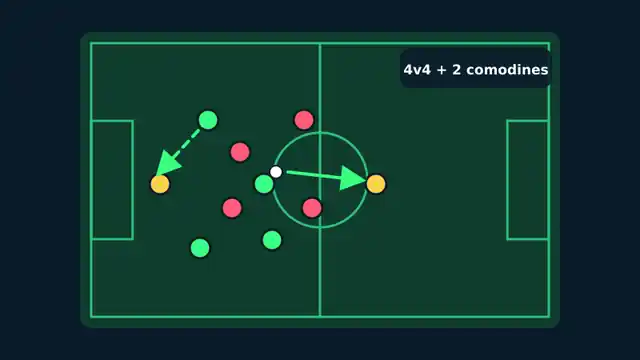
- Tension (Tuesday): 4v4+2 positional game in a small space, 3 sets of 4 minutes with 3 minutes’ rest, with a maximum of three touches and finishing after a progression.
- Duration (Wednesday): 9v9+goalkeeper on half a pitch, 2 sets of 15 minutes, with a single tactical objective, for example pressing after losing the ball.
- Speed (Thursday): 3v2 transitions chained with 2v1, with efforts of 10-15 seconds and full recovery.
- Activation (Friday): 6v6 in wide spaces and few repetitions, plus set pieces.
How to design a good drill
- Define the sub-principle you want to reinforce.
- Adjust the space, number of players and rules.
- Check that the desired behaviour appears.
- Correct with few words and at game pace.
If you are searching for “tactical periodization drills pdf”, keep in mind that many downloadable documents are compilations without context. A drill only makes sense within your game model.
How to apply tactical periodization in your team step by step
Tactical periodization planning requires order. A realistic process:
- Define your game model. Write down how you want to attack, defend and transition, with 3 or 4 ideas per moment.
- Break it into sub-principles. Turn each idea into observable behaviours.
- Design the standard morphocycle. Adapt it to your calendar and the number of sessions available.
- Build your task bank. Classify tasks by moment of the game and by dominant (tension, duration, speed).
- Evaluate with matches and video. The match is your main source of data.
- Adjust every week. Keep the pattern, but change the content according to what happened at the weekend.
If you train three days or fewer
In developmental categories or amateur teams, with 2 or 3 sessions, you can’t replicate the full pattern. Prioritise one tension-intensity session, one duration-organisation session and one activation session before the match. Better a simplified pattern well executed than a complete one poorly sustained.
Common mistakes
- Copying drills without a game model.
- Confusing each day’s name with a closed recipe.
- Training without a specific intention in each task.
- Changing the model every few weeks.
Advantages and disadvantages of tactical periodization
Advantages
- Total coherence between what is trained and what is played.
- It optimises time: the tactical, technical and physical are worked on together.
- It favours a recognisable playing identity.
- It eases communication within the coaching staff.
Disadvantages and limitations
- It demands a clear game model and a coach with a lot of judgement; without them it gets blurred.
- It is hard to apply with unstable squads or little training time.
- There is academic debate about the lack of comparative scientific evidence: a good part of its foundation is conceptual and based on practical experience, and there is criticism about how hard it is to validate through controlled trials, as noted in papers published in journals such as EFDeportes about its “unresolved questions”.
- Dosing external loads may require complementary monitoring that the original method doesn’t detail.
An honest view of the method acknowledges its strengths without presenting it as the only valid route.

Conclusion: how to get started in 2026
Tactical periodization is not a collection of drills or a Portuguese fad: it is a way of thinking about training in which the game model rules and the standard morphocycle gives order to the week. Its value lies in coherence, and its risk in copying forms without understanding the substance.
If you are going to implement it this season, start with the essentials: write down your game model, define your sub-principles, build a realistic standard week for the sessions you have available and evaluate every week against the match. Compare it with the structured microcycle, take what fits your context and don’t be afraid to adapt it. And to settle the organisational basics, go back to how to plan a soccer training session. The best periodization is the one your players understand and you can sustain throughout the season.