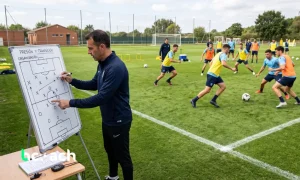
I vividly remember a pre-season from a few years ago. I had a central midfielder in my squad who aced the multi-stage fitness tests and flew through 1,000-meter track intervals. On paper, his aerobic capacity was enviable. Yet, by the 65th minute of our first competitive match, he was exhausted—unable to string together two counter-presses or track back at the speed our tactical system demanded. Sound familiar? This is where football-specific endurance comes into play.
Modern football is not track and field. It is a high-intensity intermittent sport defined by explosive accelerations, decelerations, changes of direction, jumps, physical duels, and, crucially, decision-making under severe fatigue. Running continuously in a straight line for 45 minutes no longer prepares a player for the real demands of the game in 2026.
In this comprehensive guide, we will break down how to design, quantify, and apply metabolic and neuromuscular endurance training that directly translates to on-pitch performance.
What is football-specific endurance and why does classical theory fall short?
Football-specific endurance is defined as a player’s ability to repeatedly perform high-intensity actions (RSA – Repeated Sprint Ability) across 90 minutes while maintaining optimal technical and tactical efficiency and minimizing recovery time between efforts.
Classical physiology categorized training into isolated “aerobic” and “anaerobic” boxes. However, a football player’s metabolic profile is a dynamic hybrid:
- Phosphagen System (ATP-PCr): Fuels explosive sprints, vertical jumps, and striking (efforts lasting 1 to 6 seconds).
- Glycolytic Pathway: Supplies energy during prolonged pressing sequences or counter-attacks (efforts lasting 15 to 45 seconds).
- Aerobic Pathway: Serves as the engine for phosphocreatine resynthesis during incomplete recovery intervals and sustains the overall metabolic rate throughout the match.
If you only train the aerobic pathway through continuous steady-state running, you fail to adapt muscular tissue and metabolic systems to the repeated decelerations and metabolite accumulation experienced in competitive play.
Applied physiology: Insights from Live GPS data
Contemporary sports science literature (pioneered by researchers like Jens Bangsbo, Aaron Coutts, and Martin Buchheit) alongside live GPS tracking reveals the actual physical demands of modern football:
- Total Distance Covered: Between 9 and 13 km per match (depending on positional role).
- HSR (High Speed Running > 19.8 km/h): Represents 8% to 12% of total distance.
- Sprint Distance (> 25.2 km/h): Between 150 and 400 meters distributed across short bursts.
- High-Intensity Neuromuscular Actions: Between 600 and 800 events combining accelerations (> 3 m/s²) and decelerations (< -3 m/s²).
Expert Note: Decelerations cause substantial eccentric muscle damage. A player may possess an exceptional VO2 max, but without quadriceps and hamstrings conditioned for repeated braking, neuromuscular fatigue will rapidly degrade their tactical output.
Practical methods for football-specific endurance training
To optimize sport-specific conditioning, physical output must be integrated with tactical and cognitive demands. Below are the three primary methodological pillars:
1. Small-sided games (SSG)
Small-sided games are the gold standard. Modifying pitch dimensions, player numbers, and specific constraints alters physiological responses dramatically.
- Small SSGs (1v1, 2v2, 3v3 in tight spaces):
- Focus: Extreme neuromuscular load. High volume of accelerations, decelerations, and cuts.
- Metabolic response: High lactate accumulation, heart rates near maximal (>88% HRmax).
- Practical example: 3v3 + 2 neutral players in a 25×20 meter pitch. Sets of 2 to 3 minutes with 1.5-minute rest intervals.
- Large SSGs (7v7, 8v8 on open pitches):
- Focus: Linear metabolic and aerobic conditioning. Promotes HSR and top-speed sprinting over greater distances.
- Practical example: 8v8 on a 60×40 meter pitch with a 3-touch restriction.
2. Sport-pecific high-intensity interval training (HIIT)
Ball-integrated HIIT achieves high metabolic intensities without the unpredictable variability sometimes found in small-sided games.
- 15″x15″ Intermittent Drills with Technical Actions: 15 seconds of high-speed dribbling, sharp change of direction, and shot on goal / 15 seconds of active jogging recovery. Volume: 2 sets of 8 minutes.
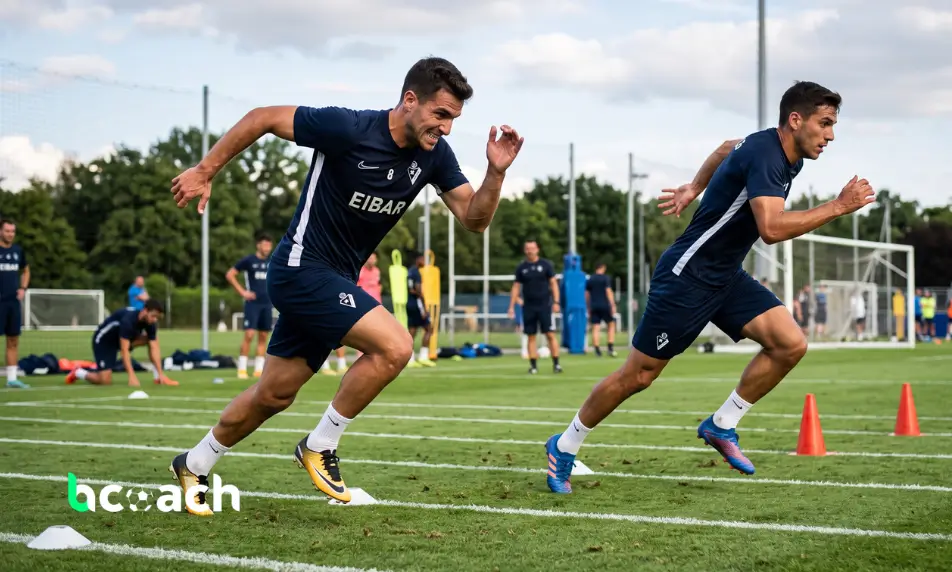
- Football-Specific RSA (Repeated Sprint Ability): 6 x 20-meter sprints featuring a 90° change of direction and an interception at the finish. Incomplete 20-second recovery between repetitions.
3. High-intensity technical-tactical circuits
Designed to replicate positional patterns from the coach’s tactical model. Players perform attacking runs, defensive shifting, aerial duels, and passing patterns under elevated physical strain.
Comparison: Traditional conditioning vs. sport-specific endurance
| Parameter | Traditional Method (Continuous Running) | Specific Endurance (SSG / Ball HIIT) |
|---|---|---|
| Decision-Making | None | Constant under acute fatigue |
| Neuromuscular Load | Low / Unidirectional | Very High (Accelerations / Braking) |
| Match Transfer | Very Low | Maximal |
| Fatigue Management | Basic cardiovascular adaptation | Cellular, muscular, and cognitive adaptation |
| Player Engagement | Generally low | High (Ball work and competition) |
Integration into the structured microcycle
Balancing these physical stimuli throughout the weekly microcycle prevents overtraining and soft-tissue injuries. For a standard Sunday-to-Sunday match schedule (MD = Match Day):
- MD+1 / MD+2 (Monday/Tuesday): Recovery and regeneration.
- MD-4 (Wednesday) – Tension / Strength Day:
- Objective: Specific neuromuscular endurance.
- Drills: Small SSGs (1v1 to 4v4), tight spaces, contact duels, and sharp decelerations.
- MD-3 (Thursday) – Capacity / Endurance Day:
- Objective: Specific metabolic endurance and large-space movement.
- Drills: Large SSGs (7v7 to 11v11), full-pitch high-intensity circuits, exposure to maximal velocity sprints.
- MD-2 (Friday) – Speed / Reactivity Day:
- Objective: Neuromuscular sharpness. Short explosive bursts with full recovery intervals.
- MD-1 (Saturday) – Activation Day:
- Objective: Tactical walk-throughs and set-piece execution.
To structure these training days efficiently, diagram exercises, and monitor squad workloads, utilizing a football coaching app is essential for streamlining planning and maximizing staff productivity.
3 Critical mistakes in football endurance training
- Using the ball without tracking load: Assuming that “playing a 5v5 automatically trains endurance” is a costly mistake. If the pitch is too large for a 2v2, it turns into an aerobic jog; if it is too small for an 8v8, players cannot reach necessary running speeds.
- Ignoring positional demands: Modern full-backs cover vastly different high-speed distances compared to center-backs. Specific conditioning must account for positional demands during the final phases of training blocks.
- Neglecting work-to-rest ratios: Training specific endurance does not mean exhausting players until technical execution breaks down. Properly timed active or passive rest preserves high movement quality on subsequent repetitions..
Conclusion
Developing football-specific endurance requires a holistic approach where physical conditioning, tactical structure, and technical execution operate together. Replicating the chaotic, intermittent, and neuromuscular demands of real match play in daily training ensures your squad arrives sharp in the 90th minute—making cleaner tactical decisions when fatigue peaks.
Apply these principles to the training ground, rely on a football coaching app to fine-tune your drill setups, and elevate your team’s match performance this season.