30-second summary
- Short answer: you need an officially recognised qualification (Sports Technician in Football) and a career plan.
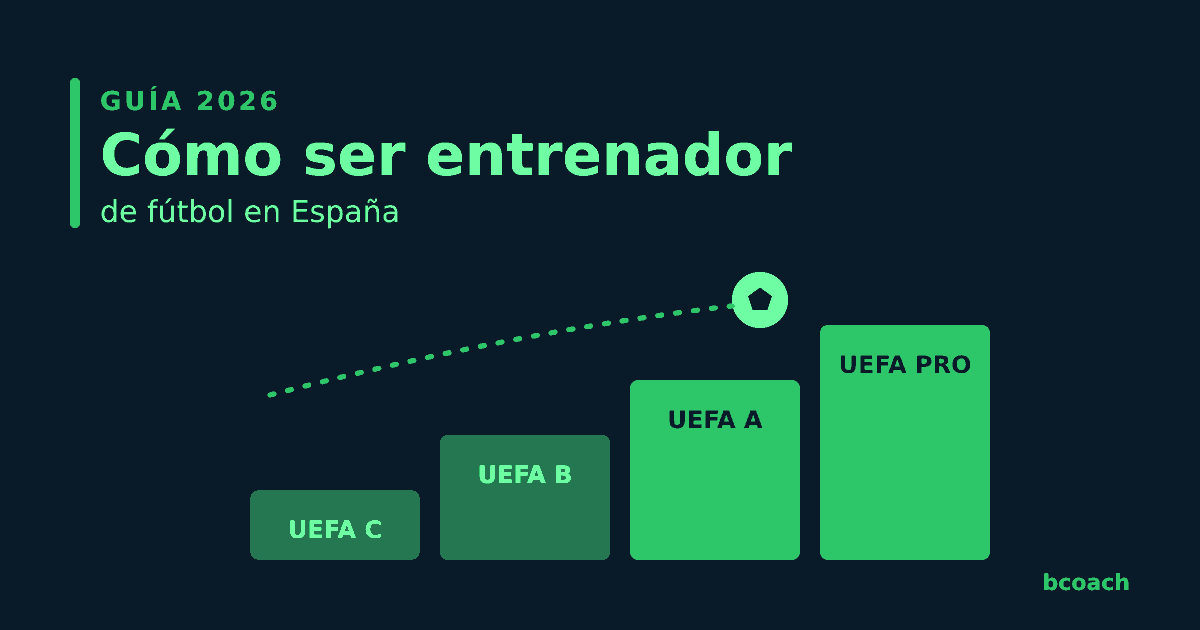
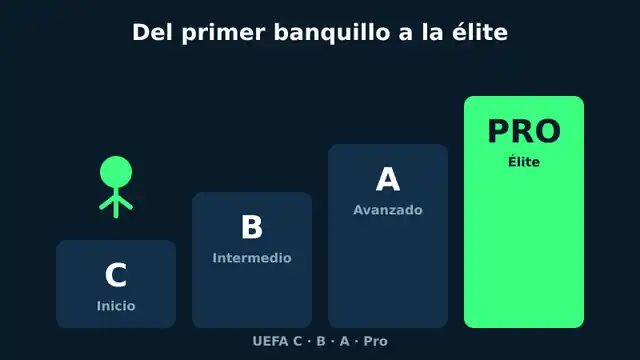
- Four levels: UEFA C (first licences and youth soccer), UEFA B (intermediate), UEFA A (national competitions) and UEFA Pro (elite).
- Each qualification opens certain benches: always check the rules of the specific competition.
- Don’t skip stages: placements and time on the bench are what make you hireable.
- Futsal has its own pathway, and plans, calls and prices vary by federation.
If you are wondering how to become a soccer coach in Spain, the short answer is that you need an officially recognised qualification and, above all, a career plan. The long answer is that the route is organised in levels that correspond to the UEFA licences, and each step opens some categories and closes others. In this guide we go through the qualification structure, the entry requirements, the university alternatives, the case of futsal and what the school brochures don’t tell you: how people actually land a coaching job.
A word of warning first: study plans, calls for applications, prices and equivalences with UEFA change with the regulations and vary by regional federation. Use this as a map and always confirm current details with your regional federation or the Royal Spanish Football Federation (RFEF) before you enrol.
How can I become a soccer coach: the big picture
In Spain there is no single route. There are three main paths, and it pays not to mix them up:
- Special-regime sports education: the Sports Technician in Football (intermediate level) and Higher Sports Technician in Football (higher level) qualifications. This is the official route and the one that gives access to federation licences.
- Federation training and coaching schools: the RFEF, regional federations and authorised schools run the courses that lead to coaching licences.
- Complementary university education: the degree in Physical Activity and Sports Sciences (CAFYD) and master’s degrees in high performance or training methodology. They add knowledge, but on their own they do not replace the coaching qualification needed to lead teams in federated competition.
It is the most common mistake among beginners: believing that a university degree or a private master’s “makes you a coach”. To sit on a federated bench you need the corresponding licence, and that goes through the official sports technician pathway.
The coaching levels: UEFA C, B, A and Pro
The RFEF and regional federations work with coaching levels linked to the UEFA licence system. The most practical way to understand it is this:
| Step | Usual reference | Who it is for |
|---|---|---|
| Entry level | UEFA C / first licences | Beginners, youth soccer and regional categories |
| Intermediate level | UEFA B | Experienced coaches who want to lead higher categories |
| Advanced level | UEFA A | Coaches of mid-level national competitions |
| Top level | UEFA Pro | Elite coaches, top professional categories |
Important: the exact correspondence between the Spanish system’s levels (Technician Levels 1, 2 and 3) and the UEFA licences is set by the recognition agreement between the RFEF and UEFA, and it can be updated. If you see different tables on different websites, it is not necessarily a mistake: many schools simplify. Always ask your federation for the document that states which UEFA licence you will obtain with each qualification.
How to become a soccer coach from scratch: UEFA C and the first level
The first step answers the question “how can I start coaching soccer?”. It is the entry point to youth soccer and regional categories.
Usual entry requirements
- Be of legal age or meet the minimum age set by the call.
- Hold the Spanish compulsory secondary education certificate (ESO) or equivalent; if you don’t, there are entrance exams for sports education.
- Pass, where applicable, the specific test or sporting requirement set by the call.
What you will learn
First-level content usually includes youth soccer methodology, basic technique and tactics, an introduction to physical preparation, the laws of the game, sports legislation, first aid and the psychopedagogy of the young athlete. Programmes combine theory classes with placements at a club.
Field advice
Many candidates leave their placements until the end and rush them at the first team that opens the door. Bad idea. Pick a club with a defined methodology and a reference coach who lets you run sessions, not just collect cones. Those placements are your first calling card and, often, your first contract.
Soccer coaching course: UEFA B and the jump to the final cycle
With the first level passed and some bench experience, the next step is the second level of the Sports Technician in Football, linked to the UEFA B licence. Here the content stops being introductory: season planning, periodization, game models, opponent analysis, team management, goalkeeper training and conditioning applied to soccer.
What changes compared with the first level
- You move from running sessions to designing a game model and justifying it.
- You are expected to manage a group with egos, absences and conflicts, not just teach fundamentals.
- Assessment values your ability to plan in the medium term, not only to lead a session.
Why you shouldn’t skip stages
Some people try to collect qualifications without spending time on the bench. It is a tactical error: competitions demand more and more licences, but clubs hire people who have shown they can manage a dressing room. A qualification without experience lets you register on federation sheets; experience is what makes you hireable.
How to become a national-level soccer coach: UEFA A
The third step corresponds to the Higher Sports Technician in Football (higher level), which trains coaches for higher-level competitions. Access usually requires the intermediate-level football qualification, the Bachillerato (upper secondary diploma) or equivalent (or an entrance exam) and, depending on the call, experience or sporting requirements.
At this level you go deeper into:
- Leading competition teams and managing performance.
- Advanced game analysis and scouting.
- Planning physical preparation and recovery.
- Managing coaching staffs and sports organisation.
- Psychological aspects, communication and leadership.
By now the difference is not knowing more theory than everyone else, but knowing how to communicate and defend it: meetings with directors, match reports, presenting the sporting project. Those who master that side usually move up sooner.
UEFA Pro: the elite qualification
The UEFA Pro licence is the top step and the one required to lead in the highest professional categories. In Spain it is tied to the top level of federation training, and access is restricted: it normally requires already holding the licence immediately below, proving bench experience and passing an admission process. Places are often limited, and your track record, your résumé as a player or coach and, in some cases, the position you hold at a club are taken into account.
What to expect
- An intensive programme with working days alongside active coaches, club visits and practical projects.
- A focus on dressing-room management and on dealing with the board, the press and the environment.
- A network of contacts that is often worth as much as the qualification itself.
Think of the Pro licence as the end of a process, not a direct goal. Those who reach it have usually spent years in lower categories building a reputation.
Which benches does each qualification allow?
Each competition sets its own qualification requirements for coaches, and the rules change, so always check the regulations of the specific competition. As a general guide:
- Youth soccer and regional categories: the first qualifications are usually enough, with different requirements depending on the federation.
- Amateur and mid-level national categories: intermediate or advanced levels are required.
- Top professional categories: the highest-level qualification or an equivalent accreditation is required.
One practical detail: clubs don’t just look at your qualification, they also check that your licence is valid and that you are properly registered with the federation. Make sure every season that your licence has been processed before you sign anything.
Futsal coach, university and other routes
How can I become a futsal coach?
Futsal has its own sports speciality and its own qualification pathway, with levels separate from those of 11-a-side soccer. Holding the soccer qualification does not automatically qualify you to coach futsal, nor the other way round. If this discipline interests you, check the offer of your regional federation and of authorised schools.
What is the degree to become a soccer coach called?
Strictly speaking, there is no university degree called “Soccer Coach”. The official pathway is Sports Technician in Football (sports education). The nearest university route is the Degree in Physical Activity and Sports Sciences, very useful for physical preparation, performance analysis and technical direction, but complementary.
Coaching outside Spain
If you are asking how to become a soccer coach in the United Kingdom or another country, each federation has its own licensing system (in England, for example, the FA). There are recognition mechanisms between UEFA federations, but they are not automatic: you will have to apply for validation and may be asked for additional training or documentation.
How to land your first team and progress
The qualification opens doors, but it doesn’t walk through them for you. These are the levers that do work:
- Start in youth soccer: it gives you training hours, cheap mistakes and a network of contacts among other coaches and coordinators.
- Document your work: sessions, plans, match videos and analysis. An organised portfolio sets you apart when a coordinator has ten identical résumés.
- Be useful on a coaching staff: as an assistant coach, analyst or goalkeeper coach you learn more than on your own.
- Master the digital tools: soccer coaching apps let you organise squads, plan sessions, record attendance and communicate with players and families. An organised coach conveys professionalism from day one.
- Look after communication with families: in youth soccer, conflicts with parents end more coaching careers than results do.
Mistakes that hold a career back
- Collecting qualifications without spending time on the bench.
- Choosing a school only on price or on how short the course is, without checking that it is authorised and that the qualification is official.
- Neglecting your federation licence each season.
- Ignoring continuing education: federations and schools run workshops and refresher courses that keep your profile up to date.
How to choose where to train
Before you enrol, check these points:
- That the centre is authorised by the education authority or the federation to deliver official sports education.
- That the qualification is official and leads to the federation licence you are after.
- That placements are guaranteed or properly guided by the school itself.
- Schedule and format: many courses combine in-person and blended classes, which matters if you work.
- Total cost: enrolment, fees, materials, travel and the federation licence. Ask for the breakdown in writing.
Be wary of courses that promise “become a coach in two weekends” or that don’t mention an official qualification: they can work as complementary training, but they don’t replace the recognised pathway.
Conclusion
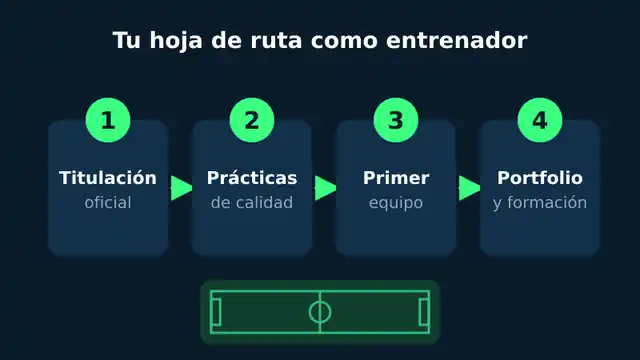
Knowing how to become a soccer coach in Spain means understanding that there is a ladder: first licences to get started, an intermediate level with UEFA B, an advanced level with UEFA A and the elite with UEFA Pro. Each rung demands study, placements and time on the bench, and none replaces the others.
Your action plan for 2026 can be simple: check the current requirements with your regional federation, choose an authorised centre, prioritise quality placements, start coaching as soon as you can and document everything you do. With an official qualification, real experience and good organisation, you will have what clubs are looking for: a prepared, reliable coach who wants to keep learning.