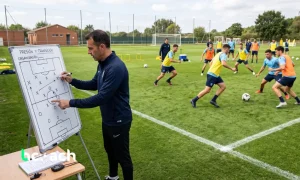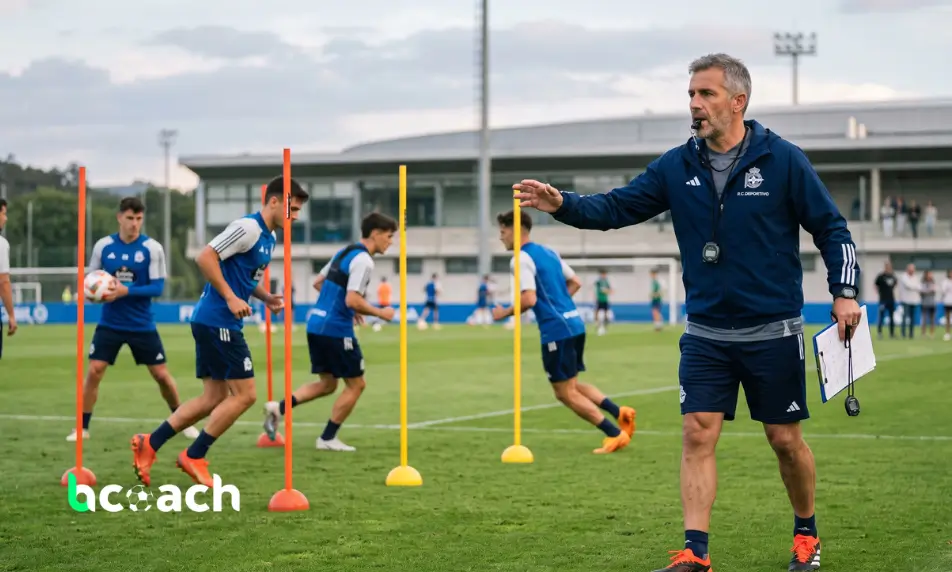
If you have spent any time in the dugout or in a club’s performance department, you have surely witnessed this scene: the fitness coach running along the touchline with ten players doing 1,000-meter repeats while the head coach waits at the far end of the pitch with the balls inside a sack. This radical divide between physical preparation and tactics is completely obsolete. Today, knowing how to structure integrated physical preparation in football is the difference between a dynamic, resilient, injury-free team and an exhausted squad that physically collapses by the 70th minute.
Modern football cannot be broken down into separate parts. A player’s brain, muscles, cardiovascular system, and decision-making operate in absolute synchrony across 90 minutes. Physical conditioning can no longer be viewed as an isolated component; it must serve as a contextualized driver that enhances the team’s game model. Below, we break down step by step how to plan and execute this methodological approach directly on the pitch.
From Laps Around the Pitch to Holistic Training: What Is Integrated Physical Preparation?
Integrated physical preparation is a methodology that blends conditional capacities (strength, speed, endurance, and flexibility) with the tactical, technical, and socio-affective dimensions of the game. Instead of isolating physical stimuli through linear running drills or unopposed obstacle courses, football itself becomes the primary conditioning tool.
This model draws directly from globally renowned training concepts such as Tactical Periodization (originally developed by Vítor Frade) and Structured Training (pioneered by Francisco Seirul·lo at FC Barcelona). Both methodologies view the football player as a hyper-complex system that responds holistically to specific match demands.
Comparison: Traditional vs. Integrated Conditioning Models
| Parameter | Traditional Conditioning | Integrated Conditioning |
|---|---|---|
| Primary Tool | Continuous running, isolated gym work, unopposed drills. | Small-sided games, positional play, conditioned matches. |
| Tactical Context | None or disconnected from the team’s game model. | Fully aligned with the team’s core tactical principles. |
| Decision-Making | Mechanical or nonexistent (closed stimulus-response). | Constant (perception, decision, and execution under real fatigue). |
| Stress Management | Purely physical and cardiovascular stress. | Integrated neuro-emotional, cognitive, and muscular load. |
| Player Buy-In | Low (often viewed as punishment or tedious work). | Very high (the ball and match-like competition lead the session). |
When working in an integrated way, the coaching staff’s central question changes from “How much does the team need to run today?” to “What neuromuscular and metabolic stimulus do we want to trigger while working on our counter-pressing?”.
The Two Main Engines: Optimizing and Complementary Training
To structure integrated conditioning systematically without neglecting vital performance metrics, the training load is split into two complementary blocks:
1. Optimizing Training (Pitch-Based, With Ball)
This includes every action taking place on the pitch wearing boots and using the ball. Its purpose is to prepare players to compete within the precise spatial, temporal, and dynamic demands of match play. Here, coaches design preferential acquisition drills—such as possession games, rondos, and conditioned matches—where tactical principles and physical demands completely overlap.
2. Complementary Training (Gym and Injury Prevention)
Certain physical adaptations and structural capacities cannot be safely, symmetrically, or reliably overloaded through open gameplay alone. This work is usually conducted off the pitch or during pre-activation blocks before team training, covering:
- Structural Strength and Functional Hypertrophy: Fundamental movement patterns (push, pull, hip-hinge, and squat/knee-dominant variations).
- Targeted Injury Prevention: Eccentric strengthening protocols (such as the Nordic hamstring curl or eccentric adductor exercises on conical pulleys).
- Stability and Mobility: Lumbopelvic (core) control and active mobility work for ankles and hips.
Competitive Microcycle Structure Step by Step (MD+1 to MD-1)
In a standard weekly setup with matches on Sundays, training loads must follow the principles of supercompensation and neuromuscular recovery relative to the Match Day (MD):
- MD+1 / MD+2 (Monday and Tuesday) – Recovery, Regeneration, and Compensatory Load:
Starters (>60 minutes) focus on active recovery, joint mobility, hydrotherapy, and low-impact light jogging. Substitutes and non-squad players perform high-intensity small-sided games (3v3, 4v4) to replicate the competitive match load. Tuesday is typically reserved for complete rest. - MD-4 (Wednesday) – Muscle Tension and Strength in Small Spaces:
The peak day for neuromuscular and mechanical stress. Sessions use small playing areas (10 to 25 meters per player) through tight possessions, 1v1 duels, and wave play (2v1, 3v2, 4v4). Key metrics: high-intensity accelerations and decelerations (>3 m/s²) and elevated Player Load per minute. Tactically, the focus is on counter-pressing, aggressive closing down, and direct individual duels. - MD-3 (Thursday) – Specific Endurance and Large Spaces:
The session with the highest overall tactical and cardiovascular volume. Teams play across large areas or full pitches (70 to 100 meters per player) via 10v10, 11v11 games, and extended transitions. Key metrics: total distance covered and high-speed running (HSR, between 19.8 and 25 km/h). Tactically, the focus shifts to defensive compactness, shifting across lines, and sustained organized attacks. - MD-2 (Friday) – Speed, Acceleration, and Sprint Exposure:
Total training volume drops significantly, but peak intensity remains absolute for short bursts. Drills feature medium-to-large spaces with full recovery pauses (work-to-rest ratio of 1:5 or higher), emphasizing 30- to 40-meter counter-attacks and rapid finishes. Key metrics: sprint distance (>25 km/h) and exposures near individual maximum sprinting speed (Vmax). Tactically, work centers on quick attacking transitions, penetrative runs, and finishing. - MD-1 (Saturday) – Activation, Reactivity, and Final Tactical Tuning:
A short, crisp session (no more than 45 minutes) designed to sharpen mental and physical readiness. Exercises include high-tempo rondos, cognitive reaction tasks triggered by visual or auditory cues, and set-piece strategy (corners, wide free-kicks).
Adaptation for Amateur Teams (3 Training Sessions per Week, Sunday Match):
- Tuesday (MD-5): Compensatory load / Structural strength + technical drills and tactical fundamentals.
- Thursday (MD-3): Peak metabolic volume and duration + collective tactical principles across open spaces.
- Friday (MD-2): Reactive speed, set pieces, and final match-plan walk-throughs.
How to Design Real Integrated Drills: 3 Practical Examples
Designing conditioned tactical tasks depends on three interconnected levers: pitch dimensions, player numbers, and specific coaching constraints.
- Small-Sided Possession with Continuous Accelerations (MD-4 / Strength):
Structure: 4v4 + 2 neutral players in a 20×20-meter grid with 4 mini-goals in the corners.
Dynamics: Maximum 2 touches per player. Teams must string together 6 consecutive passes before finishing on any mini-goal. Turnovers require an immediate 3-second counter-press rule.
Volume: 4 sets of 3 minutes with 2 minutes of passive rest between sets.
Impact: Heavy concentration of decelerations, accelerations, and sharp changes of direction with high eccentric demands. - Conditioned Positional Game in Open Space (MD-3 / Endurance):
Structure: 9v9 + 2 goalkeepers box-to-box (70×50 meters), split into 3 vertical channels.
Dynamics: Fast-tempo positional progression requiring central combinations to draw pressure before releasing runners into wide areas. Goals only count if all outfield players have advanced past the halfway line.
Volume: 3 sets of 10 minutes with 3 minutes of active recovery.
Impact: High total distance, substantial accumulation of HSR, and sustained cardiovascular output under match-like fatigue. - Express Counter-Attacking Transitions with Finishing (MD-2 / Speed):
Structure: 3v2 in the attacking half initiated by a whistle cue from the coaching staff.
Dynamics: The attacking trio has an 8-second time limit to generate a shot on target. If the defenders win possession, they have 5 seconds to find a holding midfielder stationed inside the center circle.
Volume: 2 sets of 5 repetitions per player, with 90 seconds of passive rest between runs.
Impact: Near-maximal sprint velocities (>85–90% Vmax), alactic anaerobic output, and neuromuscular sharpness with zero residual fatigue.
Load Monitoring and Technology: How to Digitize Your Planning
One common concern when leaving behind isolated running intervals is losing track of actual training load. Modern football management requires balancing objective GPS data with subjective wellness metrics to dose physical output reliably.
To centralize these variables without juggling disconnected spreadsheets, coaching staffs increasingly rely on dedicated football coaching software that unifies tactical boards, session planners, and squad load analytics into one coherent workflow.
Essential Monitoring Tools
- RPE Scale (Modified Borg): Approximately 30 minutes after each session, players rate their perceived exertion on a 1-to-10 scale. Multiplying this score by session duration gives the internal session load in Arbitrary Units (AU):
Session Load (AU) = RPE (1–10) × Duration (minutes) - GPS Metrics: For squads using GPS tracking vests, core performance indicators include Player Load (3D mechanical work), high-speed running meters (>19.8 km/h), and sprint distance (>25 km/h).
- Acute:Chronic Workload Ratio (ACWR): Compares the physical workload of the past 7 days (acute) against the 28-day rolling average (chronic). Keeping this ratio within the optimal “sweet spot” (0.80 to 1.30) minimizes injury risks while protecting performance.
Five Common Pitfalls When Implementing the Integrated Approach
Transitioning to an integrated training model requires avoiding a few common conceptual traps:
- Assuming Any Drill with a Ball Is “Integrated”: Dribbling through a line of cones unopposed offers practically zero cognitive or tactical transfer. Genuine integration demands real opponents, tactical context, and open decision-making loops.
- Completely Neglecting Maximum Velocity Sprints: Training exclusively in tight spaces (3v3, 4v4) means players rarely hit top speed. When matchday requires a full-speed 40-meter recovery run, hamstring strain risks escalate dramatically. Sprinting is the best vaccine for sprinting.
- Arbitrarily Modifying Rest Intervals: In strength and neuromuscular drills (MD-4), cutting rest short or extending it unintentionally alters the energy system being used and compromises the intended physiological adaptation.
- Disconnecting Physical Demands from Tactical Principles: Conditioning must have clear purpose within the game model. Fatigue should always be tied to the tactical behaviors and habits you expect players to display on matchday.
- Overloading the Pitch on MD-2: Expanding match sizes or ramping up volume on Fridays leads to lingering neuromuscular fatigue on matchday. MD-2 must focus purely on maximal speed, low repetition counts, and generous rest intervals.
Context Rules Modern High-Performance Football
Structuring integrated physical conditioning requires moving past antiquated, mechanical coaching philosophies. Players do not run simply to build fitness; they build fitness to execute tactical solutions cleanly and remain mentally composed through every phase of the match.
When every minute on the pitch pairs tactical concepts with targeted metabolic and mechanical demands, team performance climbs while muscle injuries drop significantly. Plan deliberately, honor the weekly load undulation across the microcycle, and harness modern coaching tools to elevate your day-to-day training process.