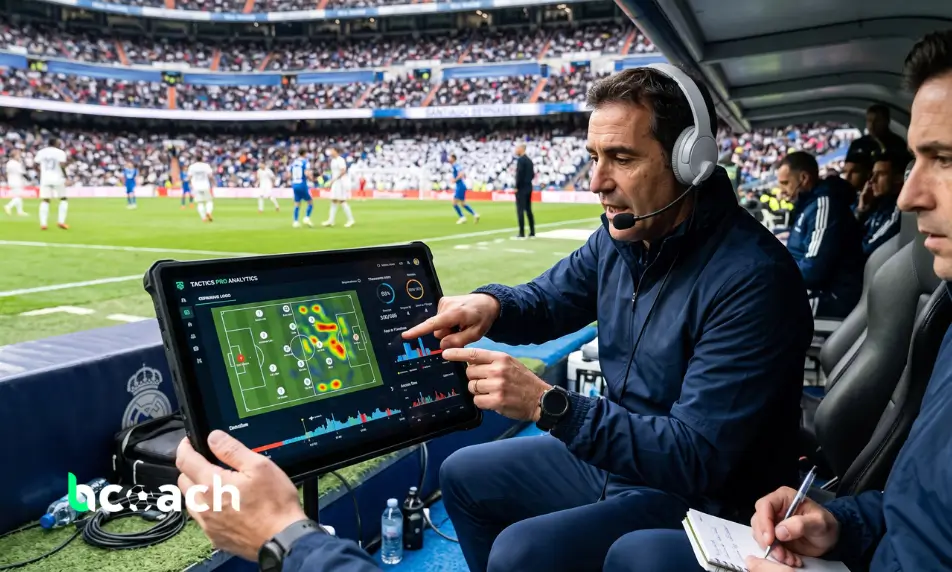
If you have spent any time in the dugout, you surely remember those Sunday nights reviewing video tapes or notebooks filled with incomplete scribbles to prepare for next weekend’s fixture. Fortunately, modern football has changed radically. Knowing how to scout and analyze an opponent in football has evolved into a smooth, dynamic, and highly precise process thanks to the use of advanced tactical apps.
In this article, we won’t stay stuck in the empty theory of coaching manuals. We are diving deep into the tactical trenches to walk you through, step by step, how to dissect any opponent’s game using the technology that fits right inside your pocket or tablet. Whether you coach in grassroots leagues, youth development academies, or the professional tier: tailoring your match plan to the opposition through digital tools is the edge separating teams that just compete from those that truly dominate.
Why the Paper Notebook Is Dead: The Digital Tactical Revolution
Not long ago, opposition analysis relied on the coaching staff’s retentive memory or handwritten sheets that ended up misplaced in the kit bag. The drawbacks were obvious: scattered data, an inability to show dynamic movements to players, and a massive waste of time.
In 2026, technology does not seek to replace a manager’s tactical eye, but rather to empower it. Using tactical mobile apps provides key advantages:
- Dynamic visualization: Today’s players are visual learners. A static graphic on a whiteboard does not convey the speed of a diagonal run or the height of a defensive line; a tactical animation does.
- Data centralization: Having the opponent’s attacking patterns, defensive shape, and set pieces gathered on a single platform streamlines decision-making throughout the week.
- Fast communication: Moving from the analysis phase to the dressing room delivery takes just one click.
Key Game Phases: What You Must Scrutinize Closely
To understand how to analyze the opposition in football with professional rigor, we must first break down the game into its four fundamental phases plus set pieces (SP). When using a tactical app, your goal is to categorize every observed pattern into these distinct blocks:
In-Possession Phase: From Build-Up to Finishing
It is not enough to simply note that a team “keeps the ball well.” You must identify the exact tactical intention across each third of the pitch:
- Build-up & ball progression: Do they build short with wide center-backs and a dropping pivot, or do they play direct, long balls into their center-forward? Watch full-back positioning: do they invert inside or hug the touchline for maximum width?
- Midfield progression & chance creation: Which areas do they favor to channel their attack? Observe whether they overload the central channel to filter passes or consistently isolate 1v1 situations out wide.
- Finishing: How do they generate their clearest chances? Analyze if they arrive via crosses (to the near or far post), shots from outside the box, or penetrating runs behind the defensive backline.
Out-of-Possession Phase: Line Heights & Pressing Triggers
Pinpointing how your opponent defends will hand you the keys to designing your weekly training drills:
- Defensive structure & line height: Do they deploy a high press to harass the build-up, a mid-block waiting in the middle third, or a low block packing the box?
- Pressing triggers: When do they trigger an aggressive press? Common triggers include a back-pass, a heavy touch, a pass out wide, or an opponent receiving with their back to goal.
- Individual weaknesses: Identify if their center-backs are vulnerable to balls in behind or if their full-backs struggle in aerial duels.
Transitions and Set Pieces
Transitions represent the most disorganized moments of any match, while set pieces decide a massive percentage of tight contests:
- Attacking transition (win – attack): Upon regaining possession, do they seek an immediate vertical counter-attack exploiting open spaces, or do they make a secure recovery pass to reset structure?
- Defensive transition (turnover – defend): When losing the ball, do they apply a relentless 5-second counter-press, or do they immediately drop into a compact retreat?
- Attacking & defensive set pieces: Analyze corners and wide free-kicks. Mark in your app whether they defend zonally, man-to-man, or in a hybrid system, and identify their main delivery takers and aerial targets.
Step-by-Step Opponent Analysis Using Tactical Apps
Here is the practical workflow you can implement right away using modern analysis tools:
- Step 1: Data gathering & match sampling.
Do not try to watch ten full games; you will drown in irrelevant noise. Select the last 3 or 4 matches played by the opponent, ideally against teams that use a formation or tactical level similar to yours. - Step 2: Digitizing patterns on interactive tactic boards.
Using mobile tactical software, translate repetitive behaviors spotted on video into animated schematics. Draw recurring passing lanes, midfield staggering, or how full-backs and center-backs cover when stepping out to press. - Step 3: Creating positional player profiles.
Collective analysis falls flat if players do not know what to expect from their direct matchups. Generate quick scouting cards in your app highlighting:- Preferred foot (right/left).
- Dominant tendency (does the winger cut inside or beat down the outside?).
- Mental profile (do they get rattled under sustained physical pressure?).
- Step 4: Integrating the report with team management tools.
An analyst’s insights are useless if not communicated effectively to the squad. Utilizing an all-in-one platform for football team management allows you to connect training drills, tactical boards, and opposition reports in a single ecosystem accessible to the entire staff. This way, when you plan Wednesday’s drill to beat the opponent’s high press, that session links directly to the visuals and clips gathered during your scouting process.
Comparison Table: Traditional Methods vs. Modern Tactical Apps
| Analysis Metric | Traditional Method (Paper / Raw Video) | Tactical App Analysis | Impact on the Team |
|---|---|---|---|
| Preparation time | High (4–6 hours per match) | Low–Moderate (1–2 hours) | Optimizes coaching staff efficiency |
| Clarity of message | Low (Static, cluttered sketches) | Very High (Clear animations & graphics) | Higher tactical retention among players |
| Real-time feedback | Impossible during the match | Instant from the technical bench | Precise tactical adjustments at half-time |
| Storage & accessibility | Physical and disorganized | Digital and cloud-based | Always-accessible archive of past matches |
5 Costly Mistakes When Delivering Reports to the Dressing Room
Knowing how to scout an opponent does not guarantee three points if the delivery to the squad falls short. Avoid these common traps:
- Information overload: Showing players a 40-minute video or handing out a 15-page dossier kills engagement. Keep it concise: the golden rule is 3 attacking keys, 3 defensive keys, and set pieces.
- Focusing entirely on the rival and ignoring your own identity: Opposition scouting should empower your strengths, not paralyze your game model out of excessive fear.
- Delivering the report too late: Players need these tactical cues by midweek so the solutions can be drilled on the pitch during preparatory sessions.
- Using overly complex jargon: Avoid over-complicated tactical terms unless necessary for your competition level. Rely on visual animations in your app so the diagrams do the heavy lifting.
- Ignoring match context: A team does not play the same when protecting a 1-0 lead away from home as they do chasing a deficit in front of their home crowd. Factor in different game-state scenarios.
Practical Example: Analyzing a 4-3-3 Opponent
- System: 4-3-3.
- Build-up pattern: Split center-backs + defensive midfielder dropping between lines.
- Observed rotation: Right-back pushes high up the pitch while right winger tucks into the half-space.
- Defensive transition: Aggressive counter-press during the first few seconds of turnover.
- Vulnerability: Space vacated behind the right-back upon losing the ball.
- Game plan: Bait their pressure toward the right side and quickly attack the vacant flank immediately after regaining possession.
Using a tactical board such as bcoach, you can illustrate this exact dynamic via animated sequences and immediately turn it into a dedicated training drill to rehearse during the week.
Tactical Analysis as a True Competitive Advantage
Mastering how to analyze the opponent in football has become an indispensable edge for any coaching staff striving to maximize squad performance. Intuition and individual flair will always be central to the game, but tactical preparation backed by clean visuals and targeted data is what tips the scale in critical moments.
Upgrade your coaching workflow: ditch endless ring binders, embrace modern tactical applications, and turn your opposition scouting into match-winning performances on matchday.