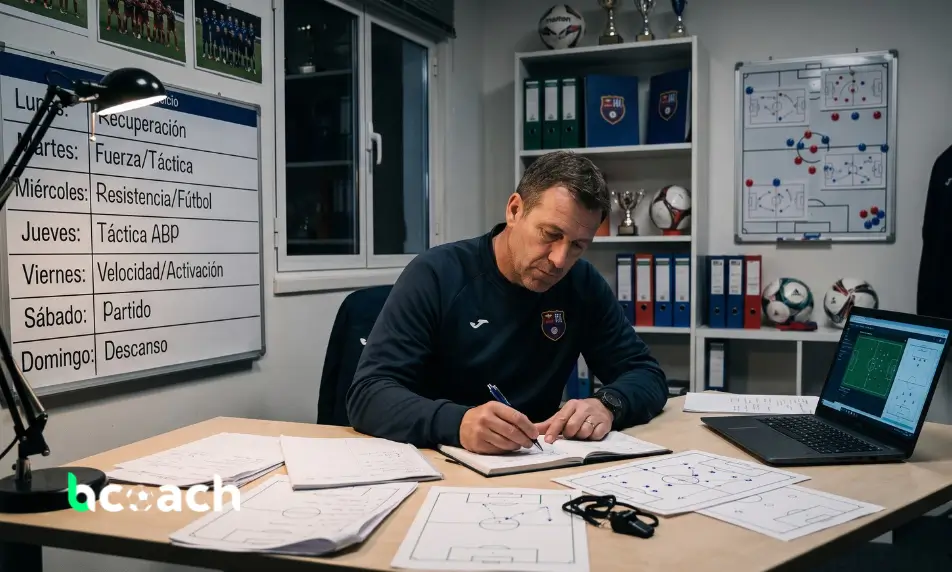
A team’s success at the weekend does not depend on luck or last-minute motivational talks. It is built minute by minute through the planning of the training week. In modern football in 2026, the football microcycle has become the fundamental operational unit for any coaching staff looking to maximise player performance and reduce the risk of injuries.
For years, coaches made the mistake of transferring training methods from individual sports to football, separating physical conditioning, technique and tactics into isolated areas. Today, we know that the game is a complex, indivisible system. Mastering microcycle planning not only allows you to ensure players reach match day in the right physical condition, but also helps you implement your playing model with conceptual clarity.
In this comprehensive guide, we will analyse how to design a football microcycle step by step, integrating cutting-edge methodologies, monitoring training loads and adapting the week to the actual demands of competition.
What Is a Football Microcycle and Why Is It the Heart of Training Planning?
A football microcycle is a planning unit that encompasses a series of training sessions organised over a week (or between two consecutive matches). It typically lasts between 5 and 9 days, with match day serving as its central reference point and fixed anchor (known as Match Day or MD).
Unlike a macrocycle (the entire season) or a mesocycle (a block of 3 to 6 weeks), the microcycle is where theory becomes practice. It is the framework in which the coaching staff adjusts physiological, cognitive and tactical variables according to three key factors:
Your playing model: the tactical principles and sub-principles that define the team’s identity.
Opposition analysis: the strengths and weaknesses of the team you will face at the weekend.
Fitness and fatigue levels: the neuromuscular and psychological responses of players following previous exertion.
A well-structured microcycle ensures that training follows the principle of specific horizontal alternation, alternating days of maximum tension, days involving large spaces and longer durations, and days focused on speed. This helps prevent the harmful accumulation of central and peripheral fatigue.
Microcycle Planning Models: Tactical Periodisation vs Structured Microcycles
Two major methodologies coexist in elite football when it comes to designing a microcycle. Although both adopt a systemic view of the athlete, they differ in conceptual and practical ways that every coach should understand.
1. Tactical Periodisation (Vítor Frade)
Developed at the University of Porto, this approach places the playing model at the centre of every training task. Physical conditioning is never detached from the context of the game. The microcycle is known as the standard morphocycle and follows a fixed structure between matches, in which tactical and physiological dimensions (tension, duration and speed) are configured according to the cognitive demands placed on the player.
2. Structured Microcycles (Paco Seirul·lo / FC Barcelona)
Based on Complex Systems Theory, this approach places the player at the centre of the process. Training tasks are classified according to how closely they resemble competition, ranging from general tasks to competitive situations. The focus is on optimising the footballer’s functional structures: socio-affective, emotional-volitional, coordinative, conditional and cognitive-optimising.
Comparison Table: Methodological Approaches
| Parameter | Tactical Periodisation | Structured Microcycle |
|---|---|---|
| Main focus | The playing model and its principles | The player’s overall needs |
| Weekly structure | Fixed standard morphocycle | Adapted to changes in the player’s fitness and condition |
| Type of training tasks | Specific and interconnected | Classified by level of optimisation (0 to 4) |
| Training load orientation | Alternation between tension, duration and speed | Combination of preferred game-simulating situations |
Regardless of which approach you choose for your coaching staff, the key to success lies in maintaining consistency throughout the training week.
Step-by-Step Structure of a 7-Day Football Microcycle (Sunday to Sunday)
To understand how training loads and tactical objectives are distributed, let’s analyse a typical seven-day week with a match on Sunday (MD). This globally standardised terminology uses MD (Match Day) to refer to match day, with previous days labelled using a minus sign (MD-1, MD-2) and subsequent days using a plus sign (MD+1, MD+2).
[MD] Match -> [MD+1] Recovery -> [MD+2] Rest -> [MD-4] Tension -> [MD-3] Duration -> [MD-2] Speed -> [MD-1] Activation -> [MD] MatchMD+1 (Monday): Recovery and Compensation
The day after a match has two completely different objectives, depending on the number of minutes played by each footballer:
- Starting players (more than 45–60 minutes): an active recovery session designed to accelerate muscle regeneration and metabolite clearance. Activities include joint mobility, low-load gym work, continuous running or cycling, and cryotherapy.
- Substitutes and players who were not selected (less than 45 minutes): a high-intensity compensatory session. It is essential to replicate the mechanical and metabolic demands they did not experience during the match to prevent physical imbalances over the medium term. Small-sided games are used with fewer players to create high-intensity acceleration and deceleration demands.
Practical dressing-room tip: Do not group recovering starters with substitutes in the same high-demand drill. The accumulated fatigue of the starters can significantly increase their risk of hamstring or adductor injuries.
MD+2 (Tuesday): Complete Rest or Cognitive Recovery
Rest is an invisible but critical part of the football microcycle. This day aims to promote supercompensation of the central nervous system (CNS) and give the squad a mental break.
Many coaches make the mistake of scheduling demanding tactical sessions on MD+2. From a physiological perspective, muscle damage caused by a match often peaks around 48 hours later, accompanied by delayed-onset muscle soreness (DOMS). Pushing the body at this stage can interfere with tissue recovery.
MD-4 (Wednesday): Strength, Muscular Tension and Defensive Sub-Principles
This is the day with the highest neuromuscular tension demands of the week. Drills are designed in small spaces (e.g. 3v3 to 5v5 positional games in 15×15 m or 20×20 m areas), where explosive-strength actions are frequent: braking, changes of direction, jumps and duels.
- Physical objective: maximum muscular tension and metabolic power.
- Tactical objective: sub-principles of the playing model, such as counter-pressing, individual pressing, defensive body positioning and covering in tight spaces.
- Volume and intensity: moderate-to-low volume, but maximum intensity per action.
MD-3 (Thursday): Endurance, Large Spaces and the Game’s Macro-Principles
Thursday is the day with the highest training volume in the entire microcycle. The dimensions of the drills are increased to replicate the space available during a weekend match.
- Physical objective: specific aerobic capacity, accumulating distance at moderate-to-high speeds and increasing total running distance.
- Tactical objective: the general principles of the playing model. Work focuses on playing out from the back, collective shifting, defensive recovery and organised attacks in 10v10 or 11v11 formats.
- Volume and intensity: very high volume with sustained moderate-to-high intensity. Recovery periods between sets are shortened to generate a degree of controlled fatigue.
MD-2 (Friday): Speed, Reactivity and Tactical Refinement
With two days remaining before the match, the fatigue accumulated on Wednesday and Thursday should begin to dissipate. Overall training volume is significantly reduced while maintaining a peak of pure speed and mental sharpness.
- Physical objective: reaction speed, acceleration over intermediate distances (10–20 metres) and muscular reactivity.
- Tactical objective: finer tactical sub-principles and adjustments based on the opposition. Rapid transitions, attacking waves, finishing patterns and decision-making at maximum speed.
- Volume and intensity: very low volume, with full recovery periods to avoid excessive metabolic and neuromuscular fatigue.
MD-1 (Saturday): Activation and Set Pieces
The day before the match is designed to fine-tune the final details and ensure players are in an optimal neurophysiological state for the following day.
- Physical objective: activation of the central nervous system through short, enjoyable exercises requiring rapid responses, such as stimulus-response drills and short activation rondos.
- Tactical objective: collective strategy and set pieces. Corner kicks, wide free kicks, penalties and tactical throw-ins.
- Total duration: on-pitch work should not exceed 45–50 minutes.
Training Load Quantification: Key Metrics for Coaches
Designing a training-load chart on paper is straightforward; the challenge is ensuring that the planned workload matches what players actually experience on the pitch. In modern football, we monitor two types of training load:
1. External Load (What the Player Does)
This is measured primarily using GPS technology and gyroscopes. The essential variables to monitor during a football microcycle are:
- Total distance (m): the overall volume of the session.
- High-speed running distance (HSR > 21 km/h): particularly important on MD-3 and MD-2.
- Sprints (> 24 km/h): the number of high-speed efforts performed.
- High-intensity accelerations and decelerations (> 3 m/s²): particularly relevant on the tension day (MD-4).
2. Internal Load (How the Player’s Body Responds)
The same physical drill can represent a very different effort for two footballers, depending on their fitness levels, sleep quality and psychological stress.
- RPE (Borg Rating of Perceived Exertion Scale): each player is asked 30 minutes after the session: “On a scale of 1 to 10, how hard was the session?” Multiplying this value by the training duration in minutes gives the session-RPE load (sRPE).
- Heart Rate Variability (HRV): an indicator of parasympathetic activity and morning recovery status.
Session Load (sRPE) = RPE (1–10 scale) x Session Duration (minutes)If the training plan calls for a light MD-2 session but the squad’s average sRPE exceeds 7, the coaching staff should immediately adjust the workload of the activation session (MD-1) to avoid players reaching match day in a state of excessive fatigue.
Adapting the Microcycle to the Fixture Calendar: Weeks with Multiple Matches
In modern football, it is common to face weeks with three matches (Sunday–Wednesday–Sunday). In these scenarios, the football microcycle is drastically shortened, and the tension-loading (MD-4) and endurance (MD-3) phases are removed.
The absolute priority becomes recovery and tactical stimulation with minimal physical impact.
Structure of a Short Microcycle (3–4 Days Between Matches)
- Day 1 after the match (MD+1): active recovery for starters and carefully controlled compensatory training for substitutes.
- Day 2 after the match / MD-1: an on-pitch tactical activation session focused entirely on the next match strategy, with very low physical demands. Extensive use of tactical video analysis helps reduce the physical workload on the pitch.
- Day 3: the next competitive match.
During these weeks, attempting to “train strength” or “work on endurance” on the pitch is a serious error of judgement that can significantly increase the risk of muscle injuries across the squad.
Common Mistakes When Planning a Football Microcycle
Even experienced coaches fall into patterns that hinder the team’s progress. Identifying these mistakes is the first step towards correcting them:
Monotony in training drills: repeating the same exercises week after week. Footballers’ brains need new adaptive stimuli to maintain high levels of concentration.
Failure to progress training-space dimensions: using small-area drills (15×15 m) on the day before a match (MD-1) places excessive strain on the adductors and hamstrings through abrupt decelerations, when players need to feel neurologically fresh.
Ignoring the cognitive load of tactical meetings: putting the squad through 45 minutes of intensive video analysis immediately before a demanding on-pitch session creates mental fatigue that affects decision-making.
Failing to adapt training loads for academy and youth players: when an academy player joins the first team for an MD-4 session, their physiological demands may be substantially higher than those experienced by established professionals, potentially creating uncontrolled training-load spikes.
Technology for Coaching Staff: How to Optimise Your Training Planning
Putting all this methodology into daily practice requires flawless organisation. The time a coach spends drawing tactics boards by hand or transferring scattered notes is time taken away from opposition analysis and squad management.
In this context, specialised digital tools have become essential for coaching staff at every level. Applications such as bcoach allow you to bring the entire football microcycle workflow together on a single platform:
- Tactical drill design: create vector graphics and animated drills that clearly illustrate tactical sub-principles to the squad before they step onto the pitch.
- Session planning: quickly structure warm-ups, main training blocks and cool-downs, assigning time slots, playing areas and specific objectives for each day of the week.
- Statistics and real-time monitoring: record data during matches and training sessions to adjust the objectives of the next microcycle immediately.
Integrating a centralised tactical tool prevents information gaps, creates a shared language across the coaching staff and presents a more professional image to your players.
Conclusion: Methodological Consistency as a Competitive Advantage
Structuring an effective football microcycle is not about copying the training sessions of Europe’s biggest clubs or applying rigid, magical formulas. It is about understanding athlete physiology, mastering your own playing model and adjusting daily training loads with common sense and scientific rigour.
From Monday’s recovery session to the final set-piece details on Saturday, every planned drill should have a clear answer to the question: “What is this preparing us for on Sunday?”
By combining a structured methodology with modern digital tools such as bcoach to design your drills and tactical boards, you will not only maximise your squad’s physical performance but also take a decisive step forward in your development as a professional coach.