The rondo has evolved from a simple warm-up drill into the methodological heart of modern football training. Mastering football rondos is essential for any coaching staff looking to develop intelligent players who make quick decisions and can solve problems in tight spaces. In 2026, with the pace of play and defensive density in elite football more demanding than ever, the rondo has become the ultimate analytical-to-global training tool for automating tactical and technical principles.
In this comprehensive guide, we will take an in-depth look at rondo structures, variations, key rules for maximising transfer to match situations, and a selection of 10 categorised drills ready to use in your training sessions.
What Is a Football Rondo and Why Is It Essential to the Modern Game?
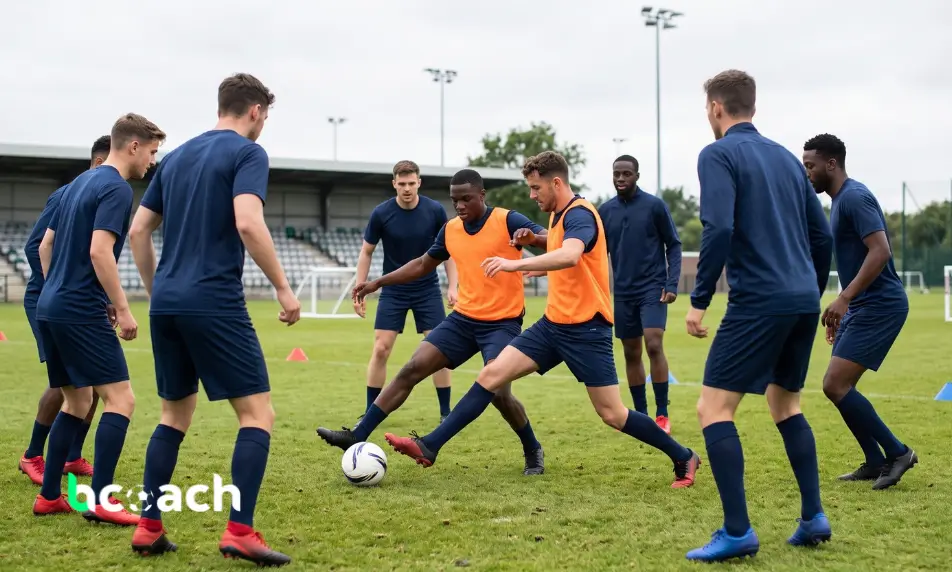
A football rondo is a training drill in which a group of outside players attempts to maintain possession against one or more defenders positioned inside a defined area. Although the concept seems simple, the rondo involves a complex network of micro-decisions, body positioning, space-time awareness and pressure management.
From Johan Cruyff’s popularisation of the exercise in the 1990s to its current tactical evolution in 2026, driven by leading coaches across Europe, the rondo has come a long way. It is no longer just about making quick passes without letting the opponent touch the ball; today, it is viewed as a simulator of real match situations.
Tactical, Technical and Cognitive Benefits of Rondos
- Cognitive processing speed: Players learn to perceive their surroundings, choose the optimal solution and execute an action within fractions of a second.
- Improved body orientation: Receiving with the far foot and positioning the body towards the available passing option are essential habits in a rondo.
- Development of the third-man concept: Encourages players to find the free player through supporting passes that attract opposition pressure.
- Immediate transitions (attack to defence and defence to attack): Develops the habit of counter-pressing immediately after losing possession and looking for a forward outlet after winning the ball.
- Social and emotional cohesion: Improves non-verbal communication, collective rhythm and tactical cooperation.
Fundamental Rondo Rules and Structural Variables
For a football rondo to produce the desired adaptations, the coach must fine-tune the key constraints. Changing the dimensions by a couple of metres or limiting the number of touches can completely alter the drill’s physiological and cognitive impact.
1. Area Dimensions
- Small areas (e.g. 6×6 m to 8×8 m): Prioritise speed of execution, technical precision under extreme time pressure and alactic anaerobic effort.
- Larger areas (e.g. 15×15 m to 20×20 m): Allow longer passes, switches of play, greater distances for body orientation and increased aerobic and physical demands on defenders.
2. Touch Restrictions
- Unlimited touches: Ideal for beginners or for practising how to attract opponents and draw them towards the ball.
- Two touches (control and pass): A golden rule of positional play. Players must know what they intend to do before receiving the ball.
- One touch (first-time passing): Maximises circulation speed and requires constant, intense support movements.
3. The Role of Neutral Players and Supporting Players
Neutral players, positioned inside or outside the area, create consistent numerical advantages (e.g. 4v4+3). They can replicate the role of a defensive midfielder or attacking midfielder in areas used to progress the ball.
Main Types of Football Rondos
Not all rondos have the same objective. When structuring your weekly training plan using tools such as the Bcoach app, it is essential to distinguish between the different types of rondos:
Possession and introductory rondos: Their main objective is to maintain possession without a specific directional target. They focus on individual technique and passing speed.
Positional rondos: Players occupy specific, symmetrical or asymmetrical areas that replicate their actual positions within the team’s playing system.
Pressing and transition rondos: Designed to emphasise the reaction immediately after losing possession or the speed of escaping pressure after winning the ball.
Movement and switching-area rondos: Structures comprising several sub-areas in which possession must be transferred through penetrating passes or off-the-ball movements.
Comparison Table of Rondo Types
| Rondo Type | Main Focus | Typical Dimensions | Players | Cognitive Complexity |
|---|---|---|---|---|
| Basic Possession | Passing speed and support | Small (6×6 m) | 4v1 / 5v2 | Low |
| Positional | Tactical structure and roles | Medium (12×12 m) | 4v4+3 / 6v3 | High |
| Quick Transition | Counter-pressing and escaping pressure | Medium to large | 4v2 to 2v2 with outside players | Medium to high |
| Complex Sector-Based | Playing out under pressure and third-man combinations | Variable across zones | 8v4 / 6v6+2 | Very high |
10 Rondo Drills by Category for Your Training Sessions
Below is a practical selection of 10 football rondo drills organised into four methodological categories.
Category 1: Introductory Rondos and Technical Possession
Drill 1: Classic 4v1 Rondo with Changing Touch Restrictions
- Area: 7×7 metres.
- Players: 4 attackers around the perimeter and 1 defender in the centre.
- Organisation: The outside players maintain possession. Start with unlimited touches. Once the group completes 8 consecutive passes, the restriction changes to a maximum of 2 touches. After 15 passes, players must use 1 touch. If the defender wins or touches the ball, they switch roles with the player responsible for the mistake.
- Tactical coaching point: Maintain maximum width within the square and prepare the supporting foot before receiving.
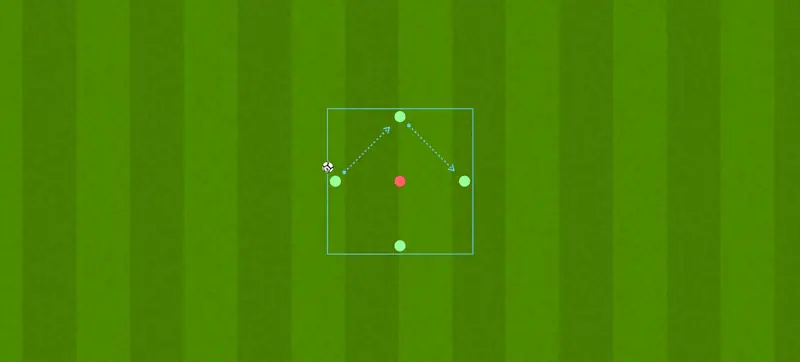
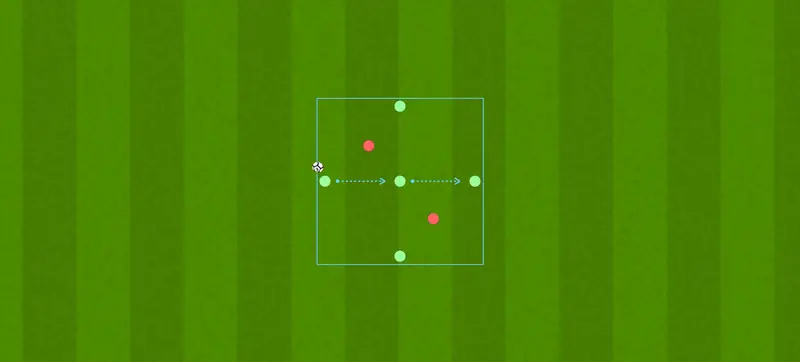
Drill 2: Traditional 5v2 Rondo with Supporting Passing Lanes
- Area: 10×10 metres.
- Players: 5 attackers (4 on the sides and 1 in the centre) against 2 defenders.
- Organisation: The central player acts as a link between the sides. The objective is to connect with the central player to switch the ball to the opposite side. If the defenders win possession, they must dribble out of the square to secure the turnover.
- Tactical coaching point: Look for a penetrating pass into the central player when the defenders drop deeper.
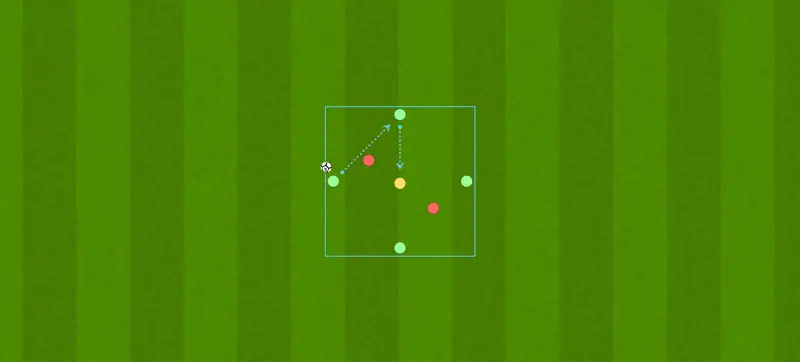
Drill 3: 4v2 Rondo with a Mobile Floating Neutral Player
- Area: 8×8 metres.
- Players: 4 outside players, 1 neutral player inside the square and 2 defenders.
- Organisation: Basic possession drill. The inside neutral player is restricted to one touch. The defenders work as a pair: one presses the player in possession while the other covers the inside passing lane.
- Tactical coaching point: Commit the defender before releasing the ball to the neutral player.
Category 2: Positional Rondos and Tactical Interactions
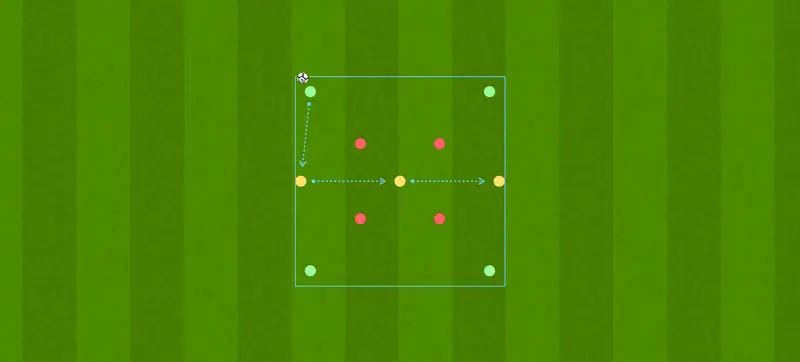
Drill 4: Structural 4v4+3 Rondo (Positional Play)
- Area: 14×14 metres.
- Players: 4 attacking players on the outside, 4 defenders inside and 3 neutral players (2 on opposite sides and 1 in the exact centre).
- Organisation: Replicates the build-up and creation phases. The attacking team, supported by the neutral players, maintains possession against 4 defenders. If the defenders win the ball, they switch roles with the team that lost possession.
- Tactical coaching point: Find the central neutral player (the third man) to bypass the pressing line of the inside defensive block.
        [Outside Neutral Player 1]
+-------------------------------+
|      A1              A2       |
|          (Def1) (Def2)        |
|            [Neutral C]        |
|  A3     (Def3) (Def4)     A4  |
+-------------------------------+
        [Outside Neutral Player 2]
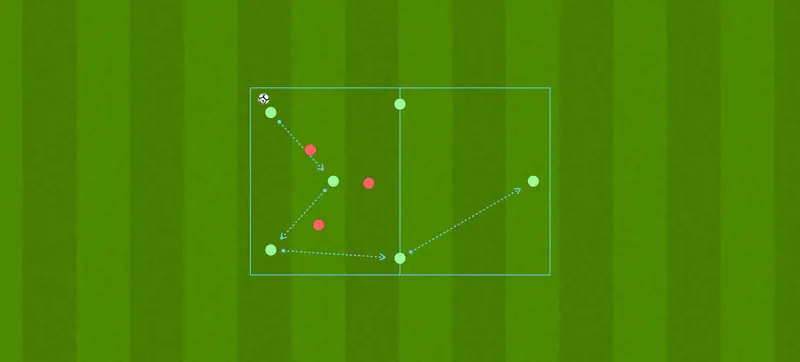
Drill 5: 6v3 Rondo with Directional Play and Switching Play
- Area: A 16×10-metre rectangle divided into two halves.
- Players: 6 attackers distributed around the perimeter and dividing line, against 3 defenders.
- Organisation: The objective is to complete a minimum number of passes (e.g. 4) in one half of the area to draw all 3 defenders towards the ball. The team then plays a penetrating pass to the opposite side, where a free teammate is waiting.
- Tactical coaching point: Attract the opposition to one side to progress or finish on the other (“draw in to create space”).
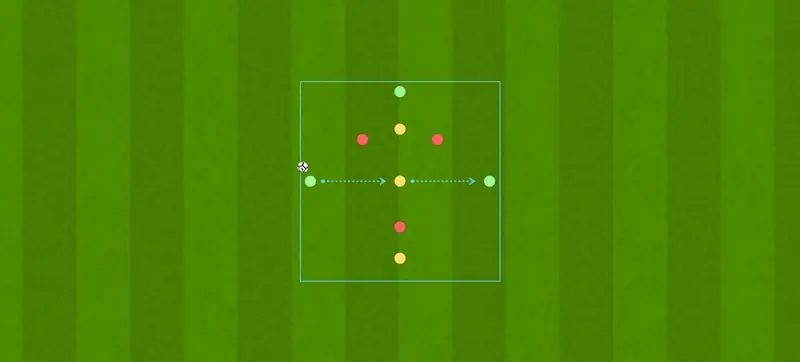
Drill 6: 3v3+3 Rondo Focused on the Third-Man Concept
- Area: 12×12 metres.
- Players: 3 teams of 3 players: one team in outside possession, one team defending inside and one team acting as neutral players to connect play through the central vertical axis.
- Organisation: Direct passes between players on adjacent sides are not allowed when the passing lane is blocked. The ball must be played into the central neutral player, who then lays it off first time to the free third man.
- Tactical coaching point: Use a diagonal body position to see the final receiver before the first touch.
Category 3: Pressing, Intensity and Transition Rondos
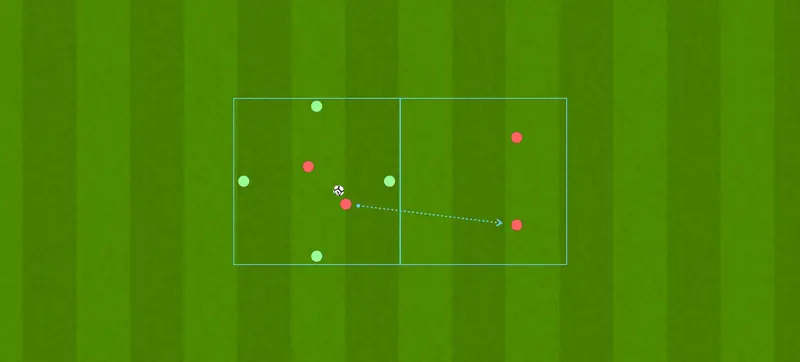
Drill 7: 4v2 Rondo with Transition and Zone Switch After Winning Possession
- Area: Two adjacent 8×8-metre squares.
- Players: 4 attackers in Zone A, 2 defenders in Zone A and 2 waiting players in Zone B.
- Organisation: Play a 4v2 in Zone A. If the 2 defenders win the ball, they must immediately play a long pass into Zone B. After the pass, the 2 defenders from Zone A rest, 2 attackers from Zone A move across to defend in Zone B, and play restarts in the other area.
- Tactical coaching point: React immediately after losing possession by pressing the player who wins the ball before they can play the outlet pass.
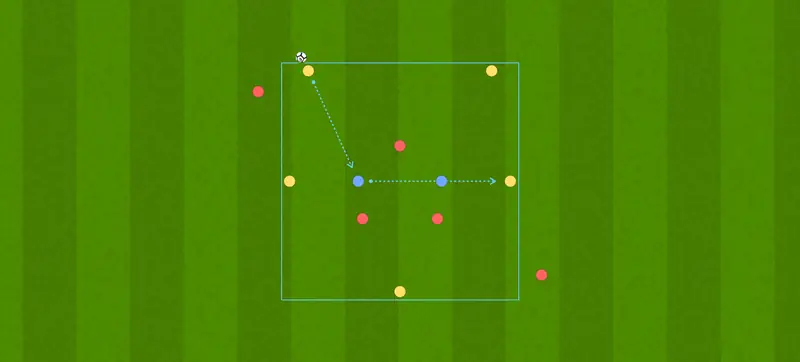
Drill 8: High-Intensity 5v5+2 Rondo in Waves
- Area: 15×15 metres.
- Players: 5 yellow players, 5 red players and 2 blue neutral players.
- Organisation: Start with 5 players plus 2 neutral players against 3 red defenders, while the other 2 red players wait on the perimeter. If the 3 defenders win the ball, they connect with their 2 outside teammates and possession changes. Pressing players enter in high-intensity waves every 30 seconds.
- Tactical coaching point: Maintain maximum width and passing tempo to tire out the pressing block.
Category 4: Complex Rondos and High Cognitive Demand
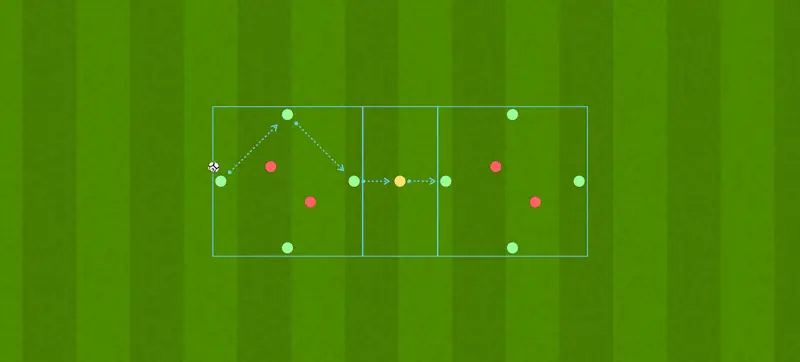
Drill 9: Double-Area 4v2 + 4v2 Rondo with a Connecting Neutral Player
- Area: Two 8×8-metre squares separated by a 4-metre central channel.
- Players: 8 attacking players, 4 defenders and 1 connecting neutral player in the central area.
- Organisation: A 4v2 is played in Zone 1. After completing 5 passes, the team can connect with the neutral player in the central channel. This player must turn or set the ball back to transfer play into the square in Zone 2, where another 4v2 begins. Two defenders switch zones during the transition.
- Tactical coaching point: Recognise the exact moment to break through the lines and switch the focus of play.
Drill 10: Dynamic Rondo with Changing Rules and Audio/Visual Stimuli
- Area: 10×10 metres.
- Players: 5v2 + 1 neutral player.
- Organisation: At the coach’s audio or visual signal (e.g. raising a coloured cone), the touch restrictions change in real time, switching from two touches to one touch or requiring the ball to circulate in a specific direction. If a player fails to adapt on their next pass, their team becomes the defending team.
- Tactical coaching point: Develop cognitive flexibility and maximum concentration under accumulated fatigue.
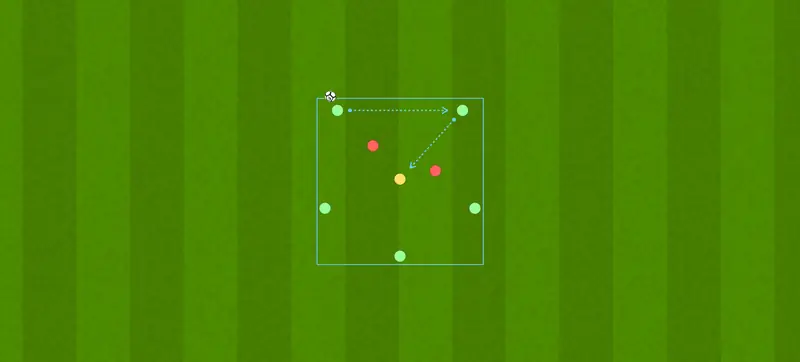
How to Plan and Design Rondos Using Digital Tools Like Bcoach
Designing drills by hand in a notebook or on a traditional tactics board is becoming outdated in professional football training in 2026. To ensure proper methodological progression and communicate drills clearly to the squad, specialised software is essential.
With the Bcoach app, coaches can:
- Design drills graphically and intuitively: Create playing areas, position neutral players, mark zones with colours and illustrate passing sequences or off-the-ball movements.
- Manage training loads and timing: Schedule work and rest intervals according to the specific type of rondo, such as anaerobic rondos versus tactical and positional rondos.
- Animate drill diagrams: Visually demonstrate the rondo’s dynamics to players before they step onto the pitch, including zone transitions and defensive rotations, reducing downtime during the session.