Throughout my more than fifteen years on the pitch, coordinating youth academies and coaching development teams, I have witnessed a recurring pattern: coaches obsessed with collective tactics in eight-year-old players who are still struggling to dissociate upper-body movements from lower-body movements. The methodological reality in 2026 is clear: without a solid foundation of motor literacy, individual technique breaks down under high spatial and temporal pressure.
Football coordination drills are not simply filler activities for the warm-up or visually appealing circuits involving cones and agility ladders designed for social media. They provide the neuromuscular foundation for decision-making, execution speed and injury prevention. In this guide, we break down a rigorous methodology based on applied neuroscience and sensitive periods of motor development, organised by age group so you can implement it directly in your training sessions.
Why Coordination Is a Cornerstone of Tactical Performance in Youth Football
In current scientific literature and the practical work of leading international academies, coordination is defined as the neuromuscular ability to regulate internal and external forces to perform a motor task efficiently and economically.
A player with poor motor control devotes a disproportionate amount of conscious attention to controlling their own body. Conversely, when coordination patterns become automatic, the footballer’s brain frees up cognitive resources for reading the game: scanning the surroundings, anticipating opposition pressure and executing a pass with precisely calibrated force.
Key Coordination Abilities in Football
To design truly functional football coordination drills, we must break this ability down into its fundamental components:
- General dynamic coordination: Whole-body movements involving major muscle chains, including running, jumping and turning.
- Foot-eye coordination: Matching visual information with a motor response involving the foot or leg.
- Kinesthetic differentiation: The ability to adjust the intensity and precision of applied force, which is essential for receiving the ball on the back foot and passing.
- Spatial and temporal orientation: Positioning the body in relation to the ball, teammates, opponents and pitch markings.
- Balance (static and dynamic): Maintaining the centre of gravity during unstable situations, such as challenging for a loose ball or dribbling past an opponent.
- Rhythm and frequency changes: The ability to vary stride frequency to adapt to the unpredictable movement of the ball or opponent.
Sensitive Periods of Motor Development: The Window of Opportunity
Training coordination without respecting an athlete’s maturation stage is inefficient and, in some cases, counterproductive. Neuroscience shows that the nervous system undergoes important periods of plasticity before puberty. This period is often referred to as the coordination window of opportunity.
| Category | Age Group | Main Coordination Focus | Dominant Cognitive Stimulus |
|---|---|---|---|
| Early development / Under-8 | U6 / U8 | Fundamental movement patterns, laterality and body awareness | Play-based activities, exploration and simple sensory stimuli |
| Under-10 / Under-12 | U10 / U12 | Ball-specific coordination, rhythm and spatial orientation | Decision-making under spatial pressure |
| Under-14 / Under-16 | U14 / U16 | High-intensity coordination, adaptation following the pubertal growth spurt and biomechanical recalibration | Complex situations, accumulated fatigue and dual-task activities |
If you fail to build a solid neuromotor foundation between the ages of 6 and 12, asking a youth player to make millimetre-perfect adjustments to their foot placement before shooting will be an uphill battle.
Football Coordination Drills for U6 and U8 Players (Discovery Phase)
At the early development and U8 stages, the objective is not to perfect the biomechanics of a foot strike, but to enrich the player’s motor repertoire. We should prioritise movement variability over systematic repetition.
Drill 1: The Hunter and the Colour Map
- Objective: General dynamic coordination, spatial orientation and braking with changes of direction.
- Area and equipment: A 15×15-metre square with cones in four different colours randomly distributed throughout the area.
- Organisation: All players dribble their own ball freely. When the coach calls out a colour (“Red!”), they must dribble towards the nearest cone of that colour, stop the ball under their sole, perform a single-leg hop over the cone and resume dribbling into the free space.
- Fun variation: One player acts as the “hunter” without a ball and tries to tag anyone who fails to stop their ball at the cone of the announced colour within three seconds.
Drill 2: Agility Ladder with Ball Integration
- Objective: Foot contact frequency, foot-eye coordination and upper- and lower-body dissociation.
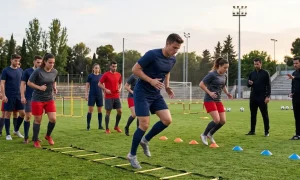
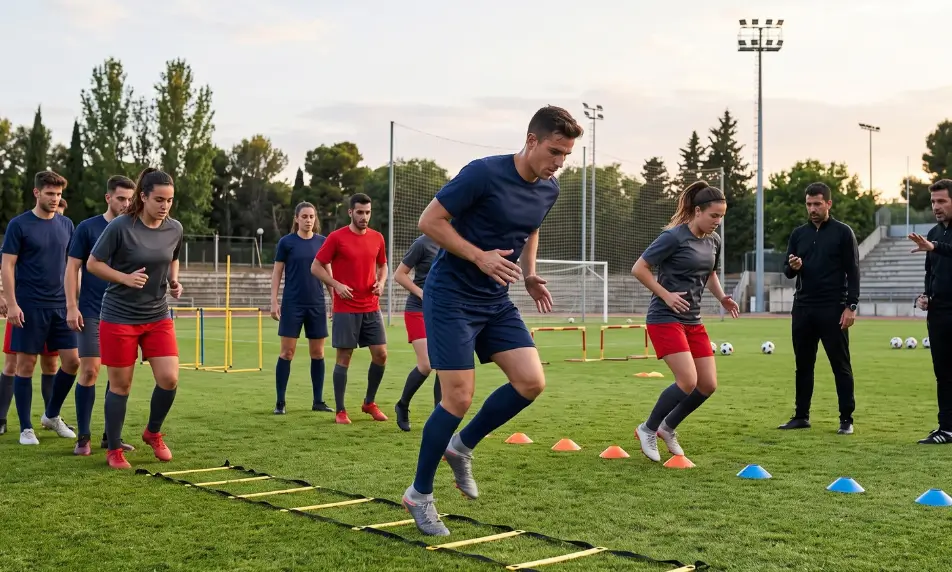
- Organisation: Set up an agility ladder. The child performs a simple footwork pattern, making one contact in each space. Immediately after exiting the ladder, they receive a gently rolled ball and must return it with a first-time pass using the inside of their non-dominant foot.
- Expert tip: At this age, do not become obsessed if players lose their rhythm on the ladder because they are looking at the ground. Corrections should be progressive. Encourage them to lift their heads by showing visual cue cards as they move through the ladder.
Football Coordination Drills for U10 and U12 Players (Consolidation Phase)
This is the golden age of motor learning. Children have a well-developed sense of body awareness and an excellent capacity to acquire new skills. It is the ideal time to link football coordination drills directly to the demands of the real game: sharp changes of direction, induced instability and precision under opposition pressure.
Drill 3: Analytical-to-Situational Coordination Circuit with a 1v1 Duel
- Objective: Foot-placement adjustments, changes of pace, motor readjustment and acceleration following a loss of balance.
- Drill structure:
Phase A (Pure coordination): Start on the agility ladder, using a pattern of two steps inside and one step outside laterally, at maximum footwork frequency.
Phase B (Spatial adjustment): Perform a two-footed jump over two mini-hurdles, landing on one leg and maintaining balance for one second to develop core and knee stability.
Phase C (Transfer to the game): The coach plays a loose ball into a neutral area. The player sprints to compete in a 1v1 duel against a teammate who has completed a mirrored circuit on the opposite side.
[Agility Ladder] ---> [Mini-Hurdles (Jump/Balance)]
                                  |
                                  v
                   [Loose-Ball Area (1v1 Duel)]
Drill 4: Cognitive Coordination Rondo and Technical Precision
- Objective: Hand-eye and foot-eye coordination in a passing context, alongside kinesthetic differentiation.
- Organisation: Set up a 4v1 rondo. The outside players pass a football between themselves, following the direction of play. At the same time, they must pass a tennis ball between their hands in the opposite direction to the football.
- Neurological impact: This type of dual-task activity forces the brain to automate foot-passing control while conscious attention is focused on throwing and catching the tennis ball. This simulates the attentional demands of a match.
Football Coordination Drills for U14 and U16 Players (Specialisation Phase)
At the U14 and U16 stages, we face the challenge of peak height velocity (PHV). Players experience a rapid growth spurt that alters their centre of gravity, temporarily affects their coordination and changes their body awareness. At the same time, the speed of the game increases significantly.
Drills at this stage should be physically demanding and replicate the biomechanical patterns of real match situations, including eccentric braking, deceleration and reactive changes of direction.
Drill 5: Reactive Deceleration and Change-of-Direction Circuit (CODA)
- Objective: High-speed foot-placement coordination, reactive lower-body strength and responses to unpredictable stimuli.
- Organisation:
The player performs a 10-metre sprint at 100% intensity.
At the 10-metre mark, they enter a two-metre braking zone where they must perform a deceleration step, using short adjustment steps to lower their centre of gravity.
Immediately afterwards, the coach displays a coloured cone (green = right, yellow = left) or gives a verbal command.
The player performs an explosive 45-degree cut in the indicated direction, receives a firm pass and delivers a cross or takes a shot on goal within three seconds.
Drill 6: Dynamic Footwork Circuit with Passive Opposition in a Small Area
- Objective: Coordination during physical contact, lumbopelvic stability (core stability) and foot-placement adjustments under pressure.
- Organisation: One player moves through a line of mini-cones using lateral crossover steps while a teammate applies lateral pressure using a fitball or contact pad. After leaving the contact area, the player receives a low pass with a slight bounce, takes a controlled first touch into space and plays a through ball between two stationary mannequins.
Methodological Integration: How to Include Coordination in Your Training Sessions
One of the most common mistakes in youth football planning is isolating coordination in a corner of the pitch as though it were an independent discipline. For coordination training to be genuinely effective, it must follow a coherent progression within the structured microcycle.
Guidelines for Training Sessions
Placement within the session: Pure coordination drills requiring a high level of nervous system activation should always be scheduled at the beginning of the main training block or at the end of the dynamic warm-up, when central fatigue is minimal.
Volume and intensity: Prioritise quality over quantity. Use short sets, with each repetition lasting between 6 and 10 seconds, followed by full recovery periods (a work-to-rest ratio of 1:4 or 1:5) to maintain maximum neuromuscular execution speed.
Progression of variability: Move from closed, predictable tasks (analytical drills) to open, unpredictable situations (situational drills) as the training week progresses.
Using Technology in Training Planning: The bcoach Experience
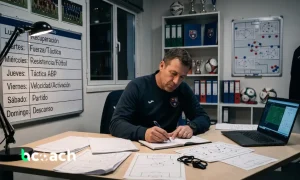
For coaching staff, maintaining a clear record of the coordination stimuli received by each age group is essential. In my day-to-day work with tools such as bcoach, I tend to categorise coordination drills according to their level of specificity: analytical, integrated or global.
Designing these drills on the bcoach digital tactics board allows us to show players exactly where we want them to place their feet when braking or how we want them to adjust their movement frequency before stepping onto the pitch. This significantly reduces explanation time on the field and increases effective practice time (EPT), which is crucial when you only have three 60-minute training sessions per week.
Conclusion: Building a Culture of Movement in Youth Academies
Training coordination is not about piling eye-catching equipment onto the pitch to impress parents watching from the stands. It is about giving young footballers the neurological and motor skills they need to respond fluently to the unpredictable complexity of the game.
A well-coordinated player reads the game faster, uses energy more efficiently, executes technical actions more accurately and, above all, is less susceptible to injuries throughout their sporting career. Use modern planning tools to structure your drills, assess your players’ motor development and always prioritise execution quality over quantity.