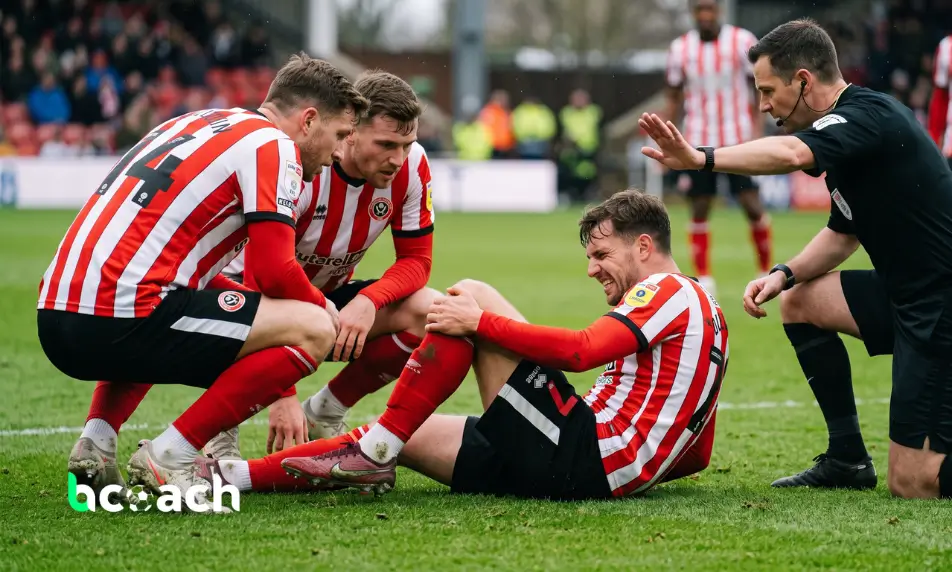
Few moments generate as much frustration for a coaching staff as the recurrence of a discomfort at a crucial point in the season. Seeing your starting winger grab his hamstring in his third match back is not just bad luck; it is usually the symptom of an incomplete rehabilitation process or flawed planning. Recurrent injuries in football represent one of the greatest challenges in the modern game, where the physical demands and match congestion in 2026 leave no margin for error.
Preventing a relapse is not merely about rest and ice. It requires an in-depth understanding of player biomechanics, quantitative workload monitoring, and an integrated on-pitch methodology. Throughout this technical guide, we will break down the root causes of injury recurrence and the best strategies to keep your squad healthy all year round.
Why Recurrent Injuries Occur in Modern Football
A recurrence (or reinjury) is defined as an injury of the same nature and site occurring within two months of a player’s return to full medical or athletic clearance. According to the UEFA Elite Club Injury Study, approximately 12% to 18% of muscle injuries in professional football are reinjuries—a figure that can surge up to 30% in youth and amateur football due to fewer monitoring resources.
The primary causes behind this issue stem from three core pillars:
- Premature Return to Play (RTP): A player’s eagerness to compete combined with competitive pressure often cuts tissue remodeling short. Even if resting pain has subsided, the scar tissue still lacks the tensile stiffness and capacity to tolerate the eccentric strain peaks characteristic of real match play.
- Persistent Strength Deficits and Asymmetries: An injured muscle may regain apparent functional tone while still retaining a 10% to 15% strength deficit compared to the healthy limb. Without assessing maximal strength, the hamstring-to-quadriceps ratio, or eccentric capacity prior to reintegration, compensatory biomechanical patterns will inevitably overload the weak link again.
- Impaired Neuromuscular Control and Proprioception: Following an injury, afferent communication between joint/muscle mechanoreceptors and the central nervous system is disrupted. Under fatigue, the central nervous system struggles with optimal motor firing patterns, leaving joints and muscles vulnerable during unpredictable actions like sharp turns, decelerations, and physical duels.
The 4 Most Common Recurrent Football Injuries and How to Address Them
1. Hamstring Muscle Injuries (Biceps Femoris)
The undisputed king of recurrences. High-speed sprinting requires extreme eccentric contraction to decelerate knee extension just before initial foot strike.
- Why it recurs: Inadequate connective tissue remodeling and a lack of maximum velocity (Vmax) sprint exposure during late-stage rehabilitation.
- On-pitch solution: Implement a progressive Nordic Hamstring protocol paired with dosed maximal sprint exposures (at least 95% of recorded top speed) once per week on high-load days (MD-3 or MD-4).
2. Ankle Sprains and Chronic Instability
The ankle joint endures immense stress from uneven turf, trapped studs, and direct contact.
- Why it recurs: Following ligament laxity (most commonly the anterior talofibular ligament), local mechanoreceptors remain inhibited, leaving the athlete playing on a “blind” ankle.
- On-pitch solution: Barefoot neuromuscular circuits during warm-ups, followed by multidirectional on-field jump-landing drills with unpredictable decision-making cues.
3. Groin Pain and Adductor Tendinopathy
One of the most debilitating conditions in football due to constant kicking mechanics and rapid changes of direction.
- Why it recurs: Strength imbalances between core musculature and the adductors, compounded by continuous shear stress across the pubic symphysis.
- On-pitch solution: Systematic inclusion of the Copenhagen Adductor Exercise throughout the weekly microcycle, alongside targeted strengthening of the gluteus medius and hip flexors.
4. Anterior Cruciate Ligament (ACL) Reinjuries
Despite long rehabilitation timelines (7–9+ months), the risk of graft failure or contralateral ACL tears remains high within the first 24 months post-clearance.
- Why it recurs: Deficits in dynamic knee valgus control during single-leg landing and abrupt deceleration mechanics.
- On-pitch solution: Re-educating braking mechanics, landing kinematics, and intensive posterior chain strengthening.
Practical On-Pitch Prevention Strategy
Minimizing injury rates across your squad requires more than static stretching. The approach must be dynamic, progressive, and synced with the competitive microcycle.
Preventive Warm-Up Framework (20 Minutes)
- 1. Cardiovascular Activation & Mobility (5 min): Low-intensity displacement, dynamic hip and ankle mobility drills.
- 2. Neuromuscular Strength & Core (5 min): Dynamic planks, Copenhagen adductors, glute bridges.
- 3. Plyometrics & Movement Quality (5 min): Single-leg hops, reactive braking, knee valgus control drills.
- 4. High-Speed Mechanics & Positional Play (5 min): Acceleration bursts, sharp changes of direction with ball work.
Workload Monitoring and Variation
The underlying trigger for many soft tissue injuries is not the training drill itself, but abrupt spikes in training load. The ACWR (Acute:Chronic Workload Ratio) framework indicates that increasing weekly load by more than 15% above the rolling 4-week average significantly increases soft tissue injury risk.
Coaching staffs must structure daily sessions to balance physical output with tactical demands. Utilizing football coaching software streamlines session design, drill logging, and workload adjustments according to prior match demands and individual return-to-play timelines.
Comparison Table: Key Injury Prevention Protocols
| Injury | Typical Mechanism | Core Preventive Drill | Suggested Frequency | Return-to-Play Milestone |
|---|---|---|---|---|
| Hamstrings | Maximal sprinting / Terminal swing eccentric overload | Nordic Hamstrings + Vmax Sprinting | 1–2 times / week | Pain-free Vmax sprint + >90% eccentric strength symmetry |
| Adductors | Hard kicking / Explosive cutting maneuvers | Copenhagen Adductor Exercise | 2 times / week | Asymptomatic adductor squeeze test |
| Ankle Sprains | Unstable ground contact / Forced inversion | Reactive single-leg perturbation hops | 3 times / week | Symmetrical Y-Balance Test & full dynamic stability |
| Quadriceps / Rectus Femoris | Ball striking / Explosive accelerations | Sissy Squats / Flywheel training | 1–2 times / week | Full passive hip extension and knee flexion recovery |
Return-to-Play Progression Protocol
When an athlete returns from injury, the transition from the treatment table to competitive play must be structured through a 5-step progression:
- Phase 1: Aerobic Capacity & Mobility: Linear off-ball running, continuous conditioning, unloaded active mobility.
- Phase 2: Change of Direction & Isolated Strength: Introduction of multi-directional movement, 70%–80% decelerations, and targeted strength work.
- Phase 3: Ball Integration & Modified Drills: Passing patterns, dribbling, and acting as a neutral/joker player (non-contact) in positional play.
- Phase 4: Full Squad Integration: Full participation in small-sided games (SSGs) and unrestricted tactical drills with opposition.
- Phase 5: Progressive Match Minutes: Gradual exposure in official matches (e.g., 20–30 minutes in match one) combined with post-match fatigue tracking.
Recurrent football injuries are not inevitable. In 2026, combining sports science, individualized physical preparation, and solid tactical planning alongside a football coaching app provides reliable tools to safeguard player health. Prioritizing strength symmetry, honoring tissue biology, and monitoring weekly workloads will make the difference between a depleted squad and a high-performing team all season long.